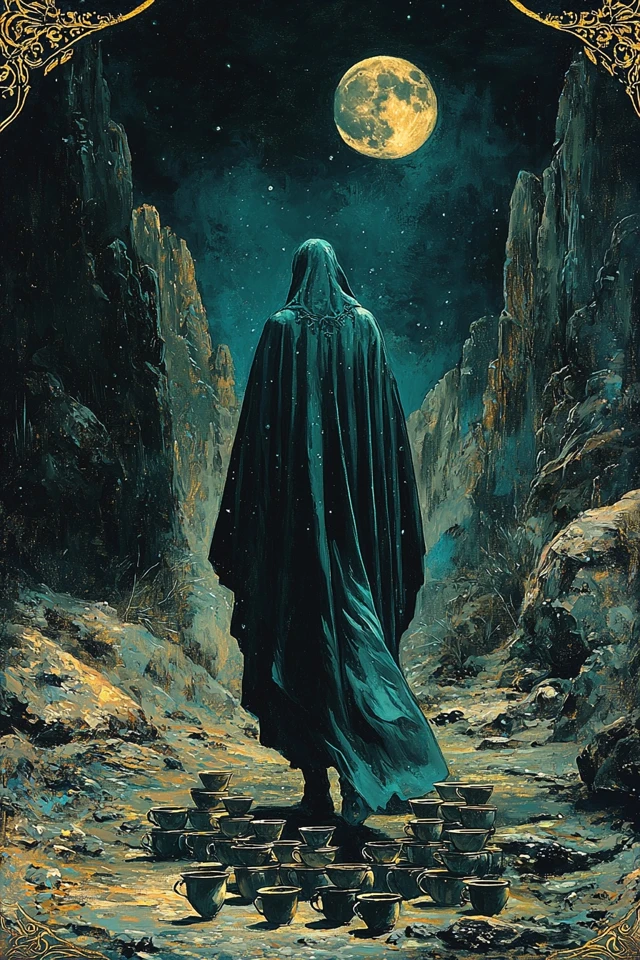
Eight of Cups
Eight of Cups says no — something needs to be left behind before you can move toward what truly fulfils you.
Upright Meaning
The Eight of Cups signals the courage to walk away from something that no longer feeds your soul, even when it is comfortable or familiar. A deeper calling is pulling you toward something more meaningful.
The Eight of Cups depicts one of the most quietly courageous acts available to a human being: the conscious decision to leave something that no longer serves, even when nothing obviously terrible has happened, even when others might not understand the departure. The figure in the traditional image turns their back on eight carefully stacked cups — these are not broken or empty but full, orderly, neatly arranged. The leaving is not about escape from disaster; it is a response to an interior signal that this is no longer where you are meant to be. This is the card of emotional integrity: honouring the quiet but insistent voice that says I have outgrown this, or this does not sustain me any longer, or there is something more authentic waiting if I am willing to move toward it. The path in the imagery ascends through difficult terrain — this is not presented as easy. But the figure walks it anyway, guided by something internal rather than external validation.
Reversed Meaning
Full Reversed Page →Fear of leaving or clinging to something long past its expiration date. Or a return to something you left behind.
Reversed, the Eight of Cups introduces a different quality of difficulty. The figure who was walking away in the upright position now faces a question: should I leave, or should I stay and try again? In some readings the reversal indicates a genuine return — someone who walked away from a situation comes back, perhaps with new perspective, perhaps with genuine willingness to engage differently. In others it describes a failure of nerve: the recognition that something needs to end, but an inability to act on that recognition. Fear of the unknown keeps a person tethered to what no longer works. The reversal can also point to the uncomfortable moment of wondering whether a departure was premature — second-guessing a choice that was actually correct. Discernment is needed to distinguish genuine return from regression.
Leaving a relationship that no longer serves your soul, or feeling emotionally unfulfilled despite apparent stability.
Leaving a stable but unfulfilling job to pursue something more meaningful.
A spiritual pilgrimage — inner or outer — calling you away from the familiar toward something sacred.
Eight of Cups in Love — Full Meaning
The Eight of Cups upright in love is the card of conscious departure. A cloaked figure walks away from eight stacked cups beneath a partly eclipsed moon, journeying into mountains. When the card appears in a love reading, it speaks to leaving — sometimes of a person, sometimes of a phase, sometimes of a version of yourself that the relationship has been keeping in place. The departure is not impulsive. The figure has built the cups carefully; what is being left was real. But something essential is missing, and pretending otherwise has become more painful than going.
For those in relationships, the Eight of Cups often signals the slow, considered recognition that the partnership is no longer nourishing what is most alive in you. There is rarely a single dramatic cause. The cups are still standing — the relationship still functions, the love may even still be present in some form — but you have come to know, quietly, that staying any longer would be a betrayal of your own truth. This card honours that knowing. It does not ask you to leave melodramatically or to make the other person wrong. It simply names what has been forming under the surface.
For singles, the Eight of Cups can describe walking away from a pattern rather than a person — leaving behind a kind of dating that no longer fits, releasing an old story about love that has run its course, or recognising that you cannot continue pursuing someone who has shown they cannot meet you. The card does not promise immediate arrival anywhere else. The mountains in the picture are far. But there is a quiet integrity to the departure, and a sense that whatever lies beyond, walking toward it is more honest than staying in cups that have grown empty.
In love, the reversed Eight of Cups raises the question of whether to stay or go in a more explicit form. The relationship may not be fulfilling you, yet leaving feels impossibly difficult — through fear, guilt, financial entanglement, or genuine love that has become complicated. Alternatively, this reversal can signal a return to a relationship after time apart, or a decision to give it one more honest attempt before walking away. Only you can assess whether renewed effort is genuine growth or prolonged avoidance.
Professionally, the reversed Eight of Cups often points to staying in a job, industry, or project that your better judgment suggests you have outgrown — out of security, habit, or fear of the uncertainty that change would bring. It can also describe someone returning to a previous career path after an attempted departure. The question is whether the return is a genuine re-engagement or a retreat. Sometimes the wisest path really is staying; sometimes it is a way of postponing necessary change.
Spiritually, the reversed Eight of Cups can describe an inability to release a spiritual framework, tradition, or community that no longer serves your genuine development — perhaps because of identity, belonging, or fear of the unfamiliar. It can also point to someone returning to a practice they abandoned, either with fresh commitment or in a way that avoids the deeper examination that prompted the departure in the first place. Honest self-inquiry is the tool this card asks you to use.
Frequently Asked Questions
The Eight of Cups represents the decision to leave behind something that is no longer fulfilling — not because it has become terrible, but because the inner self has recognised that it is no longer the right place or path. This is a card of emotional maturity and courage: the willingness to honour an interior signal even when leaving is difficult and others may not understand. It often appears when someone is on the verge of a significant transition — leaving a relationship, a job, a community, or a way of life — that is driven by genuine inner knowing rather than external crisis.
The Eight of Cups is a nuanced card in yes/no readings. For questions about whether to leave, move on, or walk away from something that no longer serves — it leans yes. It validates the impulse to honour your deeper needs even when the departure is difficult. For questions about whether to stay, invest more, or build further in a current situation — it tends toward no, or at least suggests examining honestly whether that investment is in something that genuinely sustains you. The card is less about external circumstances than about interior alignment: is what you are doing consistent with where you actually are?
In love readings, the Eight of Cups is one of the most honest cards that can appear. It often signals the recognition — sometimes before the mind has fully articulated it — that a relationship has run its course emotionally. Not through dramatic failure, but through a gradual sense that the connection no longer feeds what is deepest in you. This is not a card that encourages impulsive departure, but it does validate the experience of knowing in your body that something has ended before the formal ending. It asks whether you are staying out of genuine love or out of fear, habit, or unwillingness to face the difficulty of change.
The Eight of Cups in love speaks to conscious departure — leaving a relationship, a pattern, or a phase that is no longer nourishing what is most alive in you. The card does not depict impulsive escape but considered release: the figure has built the cups carefully and is choosing, in honest awareness, to walk on. For those in relationships, it can mark the slow recognition that staying longer would betray your own truth. For singles, it often describes leaving behind a kind of dating or an old romantic story. Departure here is not failure; it is integrity.
Not bad in the punitive sense, but sobering. The Eight of Cups acknowledges that something real is ending and asks you to honour that ending rather than deny it. The card is most painful when interpreted as rejection by an outside force. Read more accurately, it describes a choice you are already making, even if you have not yet admitted it to yourself. Where the card is genuinely about an ending, fighting it tends to prolong the pain. Where it is about a temporary departure that allows return on truer terms, the same applies. Honesty about what you already know is the medicine.
For an existing relationship, the Eight of Cups marks the recognition that something essential is missing — not necessarily love, but the alignment or depth required for you to keep building. The cups are still standing; the relationship has not been destroyed. What has changed is your willingness to keep accepting an incomplete version of what you want. The card does not always mean immediate departure; sometimes it describes the internal turning that precedes it by months or years. Honest conversation about what is missing can occasionally redirect the journey, but the card does signal that pretending nothing is wrong is no longer available.
When the Eight of Cups appears in answer to how someone feels about you, it often describes someone who has begun an internal departure — not necessarily acted on, but quietly under way. They may still care, but their attention and energy have started to move elsewhere, and the connection no longer holds them as it once did. This is rarely about another person; more often it is about an internal shift in what they need or who they are becoming. Pushing them to stay engaged while this departure is in motion tends to accelerate rather than reverse it.
Often appears with




Other 8s — the same number, a different suit

Same element — Water



More from the Cups


Popular Combinations with Eight of Cups
See how Eight of Cups interacts with other major arcana cards in a reading.