Five of Wands
Five of Wands says no — there is too much conflict and competition blocking a clear path forward.
Upright Meaning
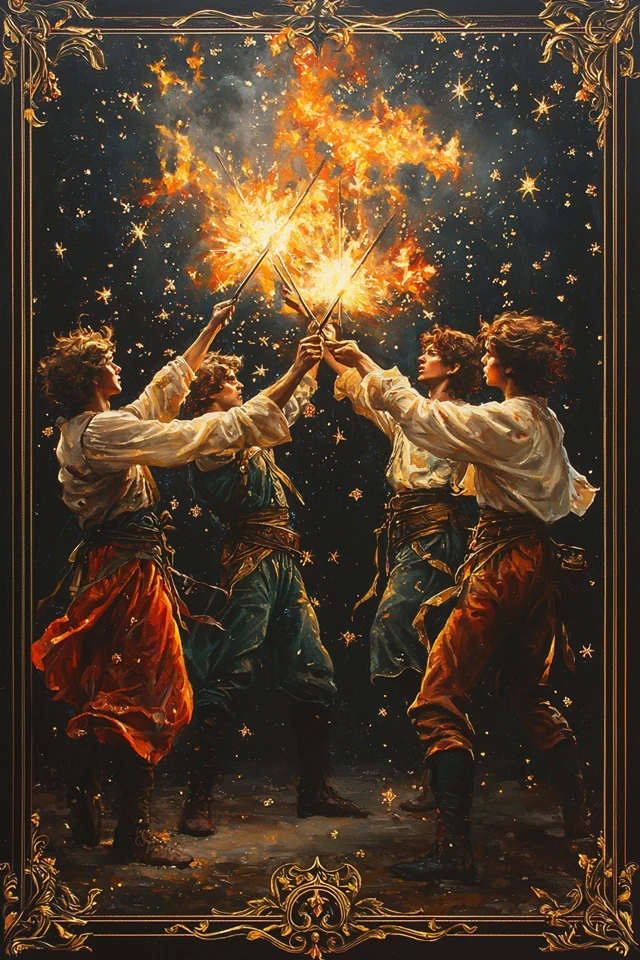
The Five of Wands brings chaotic energy, competition and conflicting forces. Multiple voices or egos are clashing. This is a challenge — but it can also be creative friction that, once channelled properly, leads to breakthroughs.
The Five of Wands describes the inevitable friction that arises when multiple strong personalities or competing ideas occupy the same space. This is not necessarily destructive conflict — it can be the productive tension of genuine debate, collaborative brainstorming that hasn't yet resolved into consensus, or the healthy challenge of competition that pushes everyone to perform at a higher level. Psychologically, the card asks how you relate to conflict and competition. Some people avoid both at significant cost to their authenticity and effectiveness; others engage but in ways that are more about dominance than genuine exchange. The Five of Wands invites a third posture: engaged, direct, confident in your perspective, while remaining genuinely open to having your thinking sharpened by opposition. It also acknowledges that not all conflict resolves tidily — sometimes you simply have to hold your ground without expecting everyone to agree by the end. The willingness to do so, without aggression, is itself a form of maturity.
Reversed Meaning
Full Reversed Page →A conflict is resolving, or you are choosing to rise above the chaos rather than engage with it.
The reversed Five of Wands can swing in two very different directions. For some, it represents conflict that has finally de-escalated — the chaos of competing agendas begins to settle and clarity emerges. This can be a genuinely welcome relief, particularly if the upright Five has been present for some time. For others, however, the reversal indicates avoidance: a retreat from necessary conflict that leaves core disagreements unresolved beneath a surface of apparent calm. Unexpressed anger or resentment can quietly accumulate in this configuration. The reversal can also point to internal conflict — a person at war with themselves, unable to commit to a direction because competing desires are not being honestly acknowledged. The task here is not to force resolution but to look honestly at what the conflict is actually about, because avoided conflict rarely disappears; it tends to resurface in less manageable forms.
Arguments, misunderstandings or competing needs creating friction in the relationship.
Workplace competition, disagreements or a scramble for recognition. Stay focused on your own work.
Internal conflict between different belief systems or values. Seek integration rather than choosing sides.
Five of Wands in Love — Full Meaning
The Five of Wands in love is the friction card — small fights, mismatched timing, competing wants, the bickering that erupts when two people who genuinely care still cannot agree on which film to watch. The card carries hot, restless fire, not the steady heat of intimacy. It is rarely catastrophic; more often it describes the squabbling phase of a relationship where everyone is jostling for position and nobody has yet remembered they are on the same team. For singles, it can show the chaos of dating multiple people, the jostle of a love triangle, or the romantic equivalent of being in a too-crowded room.
For couples, this card often points to disagreements over direction — money, family, division of labour, how often you see each other's people. None of these are unsolvable; all of them feel disproportionately heated while you are inside them. The dynamic favoured here is one of fair fighting. The Five of Wands does not ask you to suppress disagreement; it asks you to disagree better, with rules of engagement that keep the relationship intact while the argument runs its course. Avoidance is not the remedy. Skilful conflict is.
The growth edge is recognising which battles are worth lighting. Five of Wands energy tempts you to take every disagreement personally and to escalate small frictions into territorial wars. Practical guidance: name the actual issue underneath the surface squabble. Often it is one larger unsaid thing — feeling unappreciated, scared, unseen — wearing the costume of a minor grievance. Defuse that, and the petty fights stop multiplying. Love this card describes is not doomed; it is just learning to share a room. Most couples worth keeping have a Five of Wands chapter somewhere.
In love, the reversed Five of Wands often describes a relationship in which conflict is either avoided entirely or has escalated beyond productive argument into something more corrosive. If arguments are being suppressed to maintain a fragile peace, important issues are likely building beneath the surface. Conversely, if fighting has become habitual, the card invites reflection on whether disagreements are actually attempts to be heard. Learning to argue well — with honesty and care — is often more valuable than achieving the absence of conflict.
At work, this reversal can indicate a team or organisation where dysfunction has set in: competing agendas, unclear roles, and an inability to align on priorities. Alternatively, it can reflect the aftermath of workplace tension — things have calmed, but the underlying issues that sparked the conflict have not been properly addressed. It sometimes points to someone who is withdrawing from professional competition out of exhaustion or self-doubt, and the card asks whether that withdrawal is truly a strategic pause or an avoidance of necessary assertiveness.
Spiritually, the reversed Five of Wands draws attention to inner discord — the competing voices, beliefs, and desires that can make it difficult to feel settled in your values or direction. Practices that create space for honest self-inquiry, such as journalling or contemplative dialogue, can help you listen to these competing inner voices without being overwhelmed by them. Spiritual integration is not the silencing of these voices but learning to understand what each one needs.
Frequently Asked Questions
The Five of Wands represents conflict, competition, and the friction that emerges when multiple strong forces or ideas collide. It is not inherently negative — the card often points to productive tension, lively debate, or the kind of competition that sharpens thinking and raises performance. In a reading, it frequently appears when there is chaos, disagreement, or a need to assert yourself clearly among competing voices. The key question it raises is not whether conflict is happening, but whether you are engaging with it in a way that is honest and ultimately constructive rather than merely combative.
The Five of Wands is generally considered a no or a "not straightforwardly" card — not because the outcome is negative, but because it indicates conditions of disorder, competition, or obstacles that complicate a simple answer. The situation it describes is likely to require more effort, negotiation, or assertiveness than you might hope. Rather than reading it as a definitive no, treat it as a warning that the path forward requires navigating genuine opposition. If you are well-prepared for that challenge, the eventual outcome can still be positive.
In a love reading, the Five of Wands often points to friction, misunderstanding, or a relationship dynamic in which both partners are struggling to be heard at the same time. It can indicate a phase of genuine disagreement — about values, priorities, or ways of being — that needs to be worked through rather than papered over. While this is uncomfortable, the card is not necessarily pessimistic: couples who can argue honestly and still choose each other often build more resilient partnerships than those who have never tested their bond under pressure. The card encourages clarity over comfort.
The Five of Wands in love is the card of friction and minor conflict — bickering, mismatched timing, competing wants, the small fights that erupt when two people care but cannot quite coordinate. It is rarely catastrophic; more often it describes a noisy phase rather than a doomed one. For couples it can point to disagreements about direction, money or family. For singles it can show the jostle of dating multiple people or a chaotic dating-app season. The remedy is not avoidance; it is learning to disagree more skilfully.
Not bad, but uncomfortable. The Five of Wands describes friction, not failure, and most healthy relationships pass through chapters that look exactly like this card. The danger is not the conflict itself but how it is handled: contempt, escalation and stonewalling are corrosive, while honest, fair disagreement can actually deepen a bond. Treat the card as a diagnostic. Identify the larger unsaid thing underneath the petty squabbles and address it directly. Many Five of Wands chapters resolve into stronger partnerships once the actual issue is named.
For an existing relationship, the Five of Wands describes a chapter of frequent low-grade conflict. You and your partner are snapping at each other, disagreeing about small things that feel suspiciously large, or jostling over decisions that should be straightforward. The card asks you to look beneath the surface — usually one bigger unspoken issue is wearing the costume of many smaller ones. Have the harder, calmer conversation. Set rules of fair fighting if you need to. The relationship is not necessarily in trouble, but the way you handle this chapter will decide what comes next.
For dating, the Five of Wands often describes a crowded, competitive or chaotic chapter. You may be juggling several connections, navigating mixed signals, or dealing with the friction of a romantic landscape that feels noisier than it is rewarding. The card asks you to bring more focus and less reactivity to the field. Decide who is genuinely worth your attention and let the rest fall away. Healthy dating involves some friction — disagreement is not automatically a red flag — but constant low-grade conflict is a sign that the match itself, or your approach to the field, needs recalibrating.
Often appears with




Other 5s — the same number, a different suit

Same element — Fire




More from the Wands



Popular Combinations with Five of Wands
See how Five of Wands interacts with other major arcana cards in a reading.