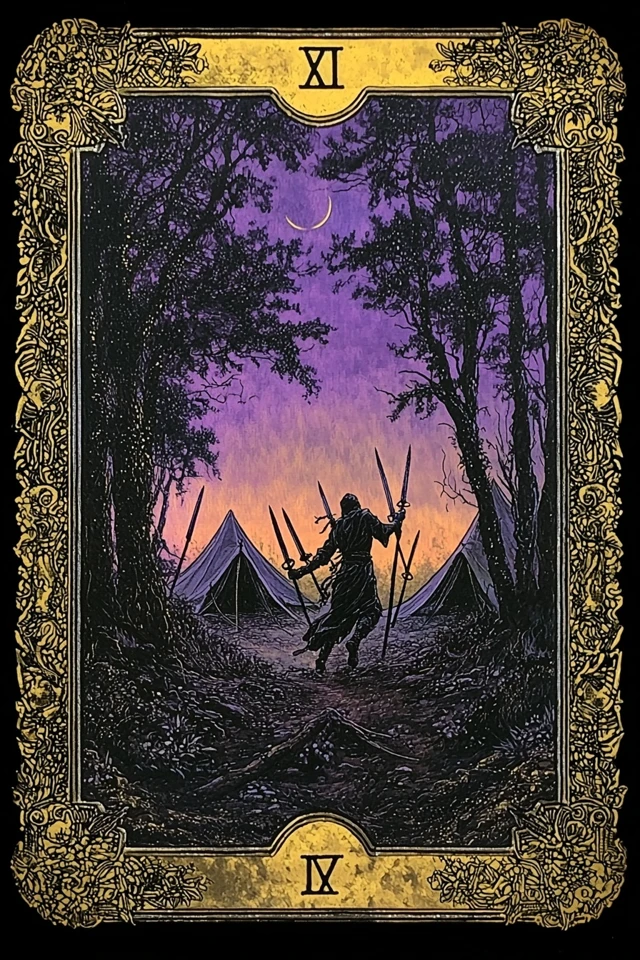
Seven of Swords
Seven of Swords says no — deception, hidden agendas or dishonesty are undermining the situation.
Upright Meaning
The Seven of Swords signals deception — either you or someone around you is not playing with full integrity. Hidden agendas, half-truths and strategic manoeuvring are at play. Proceed with eyes wide open.
The Seven of Swords carries the unmistakable energy of someone operating outside the usual rules — the figure in traditional images sneaks away from a camp, arms laden with swords, glancing back with a look that is equal parts cunning and unease. This card speaks to strategy that lives in the grey zone: the workaround, the shortcut, the manoeuvre that technically works but that you would not care to explain in detail. Sometimes this is genuinely necessary — there are situations where playing by the rules only serves those who wrote them in their own favour, and a degree of strategic independence is simply intelligent. But the card also asks you to examine your motives. Are you acting independently because the situation genuinely calls for it, or are you avoiding the confrontation that honesty would require? The seven swords are heavy; the figure cannot carry them all. Some part of this plan may be overreaching, and the glance backward suggests an awareness that what is being done may not stand scrutiny.
Reversed Meaning
Full Reversed Page →A deception is being exposed, or a guilty conscience is prompting someone to come clean.
Reversed, the Seven of Swords often brings hidden things to light — strategies that have been operating in the shadows are becoming visible, and deceptions (your own or others') are harder to maintain. This can feel exposing and uncomfortable, but the reversal often marks a positive turning point: the game-playing is over, and more honest engagement becomes possible. It can also indicate a decision to come clean about something — to stop managing a situation through evasion and to speak directly instead. Occasionally the reversal suggests that someone who has been acting deceptively toward you is about to be found out, or that you are gaining clarity about how you have been misled. The deeper message of this reversal is that sustainable progress cannot be built on a foundation of strategic half-truths.
Dishonesty, infidelity or someone not being fully transparent in the relationship.
Intellectual theft, office politics or someone taking credit for your work. Document everything.
The shadow side of intelligence — using cleverness for self-serving ends. Return to integrity.
Seven of Swords in Love — Full Meaning
The Seven of Swords in love asks an uncomfortable question about honesty. Something is being hidden, withheld, or strategically managed in a way that is not quite straight. The hiding may be small — a half-truth told to avoid conflict, a feeling tucked out of sight, a part of your life kept neatly compartmentalised — or it may be larger, the kind of secret that, once seen, will change everything. The card does not always specify which. It simply names that something is not as transparent as it looks.
This card sometimes describes you. You may be the one quietly avoiding a conversation, omitting a detail that feels safer left unsaid, or planning a private exit from a situation you have not yet been honest about. There are reasons for this — fear of conflict, fear of consequence, genuine uncertainty about what you want — but the strategy of half-truth tends to cost more than it saves. Sooner or later the hidden thing surfaces, and what was withheld weighs more than what was originally feared.
The card sometimes describes someone else. If you have been feeling that the story does not quite add up, that instinct deserves attention. The Seven of Swords is rarely paranoia; it is usually pattern recognition. Without leaping to confrontation, gather your own information quietly. Trust what you observe over what you are told. The growth edge here is the willingness to live in the truth of the situation, whichever side of it you are on. If you are the one hiding, consider what it would take to come clean while it is still on your own terms. If you are the one being managed, consider how much of yourself is going into convincing yourself everything is fine. Honesty is heavier than it looks, but it is the only foundation a love life can hold.
In love, a reversed Seven of Swords can indicate that deceptions within a relationship are coming to light — whether that is infidelity, withheld information, or simply a pattern of telling people what they want to hear rather than the truth. Alternatively, it may represent a turning point in which you or a partner decide to stop playing games and engage honestly. The relationship cannot move forward on its current foundation; transparency is the only viable path.
At work, this reversal may expose a strategy, shortcut, or approach that has not been entirely above board. This could involve intellectual dishonesty, taking credit inappropriately, or navigating office politics through manipulation rather than merit. The exposure, while uncomfortable, is an opportunity to recalibrate and rebuild credibility through more straightforward means. It can also signal that a colleague's questionable behaviour is becoming apparent to others.
Spiritually, the reversed Seven of Swords invites radical honesty with yourself about where you have been less than truthful — with others, but more importantly with yourself. Self-deception is perhaps the subtlest form of the sword's shadow, and this reversal asks you to identify the stories you tell yourself that allow you to avoid full accountability. Coming into integrity, even internally, creates a stability that evasion never can.
Frequently Asked Questions
The Seven of Swords is the card of strategy, cunning, and the grey area between cleverness and dishonesty. It appears when someone — you or another person — is operating through evasion, indirect means, or deception rather than direct engagement. This is not always malicious; sometimes the card simply reflects tactical thinking, operating independently, or finding creative workarounds to genuine obstacles. But it always raises the question of whether the approach being used could withstand full transparency. It is worth asking, when this card appears, whether you are being strategically smart or whether your approach is undermining the trust and directness on which lasting results depend.
It can suggest deception, though it rarely means something as simple or definitive as "someone is lying." More precisely, it signals that something is not being dealt with directly — that there is evasion, strategic omission, or behaviour that would not bear scrutiny. In a relationship context, this might indicate unfaithfulness or dishonesty, but it can equally point to avoidance, emotional unavailability, or someone managing their partner rather than being genuine with them. In any context, the card asks you to look at what is not being said or shown clearly, and to consider whether you are being fully straightforward yourself.
Yes — and this is one of the card's more positive readings. The Seven of Swords can represent choosing to act independently of group consensus, particularly when group thinking is flawed or when collective caution is preventing necessary action. It can speak to the lone strategist who sees what others miss, or to someone who must navigate a situation by their own lights because the usual channels are not working. The key distinction is intention and integrity: independent action in service of a genuine goal is very different from deception in service of self-interest. When the Seven appears in this context, it encourages clear-eyed, self-reliant thinking while remaining honest about methods.
It points to something hidden, withheld, or strategically managed in a relationship — sometimes by you, sometimes by the other person. The hidden thing may be small or significant; the card does not always specify. What it does say is that the current dynamic is not as transparent as it appears, and that the gap between what is happening and what is being acknowledged is becoming costly. The card asks for honesty, gently or bluntly as the situation requires. Truth handled directly nearly always weighs less, in the end, than the strategy of avoidance.
Yes. The card warns about deception, evasion, or strategic distance — including the kind you may be practising on yourself. It is not automatically predicting cheating, though it can describe that; more often it is the smaller daily dishonesties that compound. Take the warning seriously without leaping straight to accusation. Notice what is being unsaid. Watch what does not match up. If your instinct has been telling you something is off, the Seven of Swords is usually confirming that instinct rather than feeding paranoia. Pay attention to the gap between words and behaviour.
Their feelings may be more guarded or strategic than they are showing. They may be keeping part of themselves out of view — past hurts they have not disclosed, doubts they have not voiced, other connections they have not mentioned — not necessarily because they are malicious, but because vulnerability feels risky to them. This does not always mean dishonesty in the dramatic sense; sometimes it just means they are managing the impression they make on you. Take what you are told as partial information rather than the full picture, and let trust build slowly enough to test what is real.
Communication under this card tends to be incomplete. Things are being implied rather than said, edited rather than shared, or routed through other people instead of direct conversation. The card invites you to name the gap. You do not have to confront, only to bring more of the actual truth into the open — your truth first. Modelling honest, non-strategic speech often invites the other person to follow. If they cannot, that itself is information. Communication in the Seven of Swords improves the moment someone stops playing the careful game and simply tells the truth.
Often appears with





Other 7s — the same number, a different suit


Same element — Air





More from the Swords




Popular Combinations with Seven of Swords
See how Seven of Swords interacts with other major arcana cards in a reading.