Ten of Wands
Ten of Wands says no — you are carrying too much right now to take on anything more.
Upright Meaning
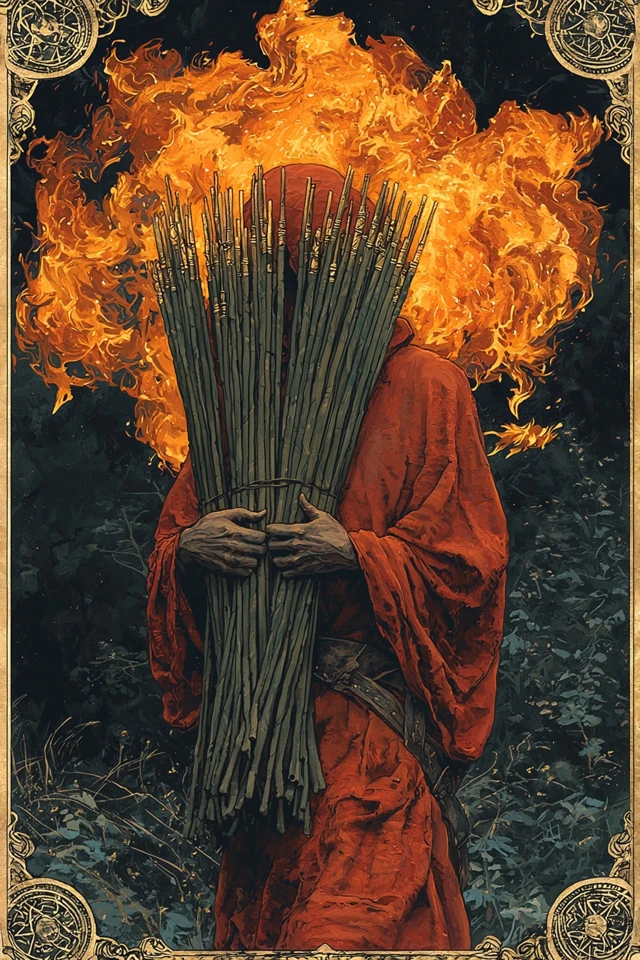
The Ten of Wands shows you carrying a heavy load. You have taken on too much and the weight is becoming unsustainable. It is time to reassess, delegate and release some of your responsibilities.
The Ten of Wands is the suit's image of accumulated responsibility — the figure bent under a heavy load of wands, trudging toward a distant destination. Crucially, the figure has taken on all ten wands themselves; this is not a burden imposed entirely from outside but one that has grown through the natural accumulation of success, commitment, and, often, the inability to delegate or let go. Psychologically, this card speaks to the particular exhaustion that comes from high achievers who add responsibility upon responsibility without asking whether each new addition is genuinely theirs to carry. There is often a pride wound tangled in here — the sense that needing help is a form of failure, or that no one else will do things to the right standard. The Ten asks you to examine whether you are carrying what is genuinely yours and to consider what might be set down, redistributed, or simply released without the catastrophic consequences you have imagined.
Reversed Meaning
Full Reversed Page →You are beginning to put down the weight, or you are struggling to let go of burdens you no longer need to carry.
The reversed Ten of Wands can represent two quite different experiences. The first is positive: an overdue release of burden — finally setting down responsibilities that were not serving you or were honestly not yours to carry, and experiencing the relief of that unburdening. This reading invites you to acknowledge that laying something down is not failure. The second, more difficult reading points to a collapse under the weight: the person who has been carrying too much for too long finally reaches a point of genuine breakdown. Here the card is not a gentle invitation but an urgent signal that something must change before the damage becomes more serious. In either case, the reversed Ten almost always involves an examination of the question of help: whether you have been asking for it, accepting it when offered, and whether you even believe you deserve it.
Feeling weighed down in the relationship or taking on too much emotional responsibility.
Overwork and burnout. You cannot do everything alone — delegate and prioritise ruthlessly.
The burden of perfectionism or over-responsibility is blocking your spiritual lightness. Learn to surrender.
Ten of Wands in Love — Full Meaning
The Ten of Wands in love is the burden card. The relationship has become heavy. You are carrying responsibilities that should be shared, or you are over-functioning to keep everything afloat, or the partnership has accumulated so much practical weight — bills, logistics, family obligations, household labour — that the romance underneath has been quietly buried. The card carries strained fire: still burning, but doing too much work for its size. It is rarely a dramatic card. It is the slow exhaustion of love that has forgotten how to be light.
For couples, the Ten of Wands often points to an imbalance in domestic load. One partner is carrying significantly more — emotional labour, planning, parenting, household management — and the other is either oblivious or quietly enabling the imbalance. The dynamic favoured here is honest renegotiation. The card asks you to put down what is not yours, ask for help with what is too much for one person, and let the relationship contribute to your life rather than just consume it. For singles, this card can describe being burdened by past relationships or by the unpaid emotional labour you do for others in your life that leaves you nothing for romance.
The growth edge is permission to put bundles down. Many Ten of Wands people pride themselves on carrying everything; the pride itself becomes part of the trap. Practical guidance: list what you are carrying. Identify what is genuinely yours, what should be shared, and what was never yours to begin with. Have the conversation that redistributes the load. Love this card describes is not doomed, but it cannot be saved by adding more weight. The fire under all that wood is still alive. Clear some of the wood and you will see it again.
In love, the reversed Ten of Wands often describes a relationship dynamic in which the emotional labour is deeply unequal — one partner carrying the weight of maintaining connection, managing conflict, and sustaining the household while the other remains relatively uninvested. The card can also appear when someone is so burdened by external demands — work, family obligations, health concerns — that they have little capacity left for their relationship, causing a slow erosion of intimacy that may not be immediately visible but is genuinely consequential.
Professionally, this reversal signals that a workload has become genuinely unsustainable. The driven, capable energy that got you to this position is now working against you by preventing you from recognising and enforcing necessary limits. It may be time to have difficult conversations about scope, capacity, and support. There is also sometimes a theme of strategic release: identifying which responsibilities, commitments, or projects are consuming disproportionate energy relative to their value, and making considered decisions about what to put down.
Spiritually, the Ten of Wands reversed asks a deceptively simple question: what are you carrying that was never yours to carry? Many burdens we accumulate through life originated in other people's expectations, fears, or unresolved pain that was passed on to us. Recognising which responsibilities are authentically yours and which are inherited — and doing the slow work of setting the latter down — is one of the more significant acts of spiritual self-reclamation.
Frequently Asked Questions
The Ten of Wands represents the exhaustion and strain that come from carrying too many responsibilities, often as the by-product of genuine ambition and success. It acknowledges the very real weight of accumulated commitments and the particular difficulty faced by people who find it hard to ask for help or delegate. The card is not critical of the effort or capability it describes — it honours both — but it asks whether the current level of burden is sustainable and whether some of what is being carried might legitimately be set down or shared without compromising what actually matters.
The Ten of Wands leans toward no, or at minimum a caution. It suggests that current conditions involve too much strain, and that taking on more — or pushing through a demanding situation without addressing the underlying burden — is likely to lead to exhaustion or diminishing returns rather than success. However, it is not a definitive no so much as a prompt to reassess before proceeding. If you can address the issue of overload — by delegating, setting limits, or releasing unnecessary responsibilities — the path forward becomes considerably clearer.
In love, the Ten of Wands often appears when external pressures are putting significant strain on a relationship — when work demands, family obligations, or personal challenges are consuming so much of a person's energy that their partnership is suffering from neglect rather than deliberate disregard. It can also speak to the emotional labour within a relationship itself: the exhaustion of being the person who holds everything together. The card invites honest conversation about what is sustainable and what each person needs in order to show up fully, rather than allowing the slow erosion of connection through unaddressed overwhelm.
The Ten of Wands in love describes burden — a relationship weighed down by responsibilities, imbalanced labour or the slow accumulation of practical weight that has buried the romance underneath. The card asks you to put down what is not yours, ask for help with what is too much for one person, and renegotiate the load honestly. For couples it often points to one partner over-functioning while the other coasts. For singles it can describe being so depleted by other obligations that romance feels impossible. Lighten the load and the fire returns.
It is a difficult card but not a fatal one. The Ten of Wands describes a relationship that has become heavy with practical and emotional labour, not one that is necessarily wrong. The fire underneath is often still alive; it is simply buried under too much wood. The card asks for honest renegotiation rather than departure. Many Ten of Wands chapters lift dramatically once the imbalance is named and addressed. The danger is staying silent and letting resentment compound. Speak up, redistribute the load, and the relationship usually breathes again.
For an existing relationship, the Ten of Wands describes a chapter of strain. One or both of you are carrying more than is sustainable — domestic labour, childcare, financial pressure, caregiving for ageing parents, the endless logistics of modern adult life. Romance has slipped down the priority list because there is no oxygen left for it. The card asks you to renegotiate honestly. Name the imbalance. Ask for the help you need. Put down what was never yours. The relationship is not doomed; it is simply exhausted. Lighten the load and most of what you miss will return.
If you are single, the Ten of Wands often describes being so weighed down by other responsibilities that romance feels impossible to fit in. Work, family obligations, caregiving, financial pressure — your time and energy are spoken for, and the idea of dating feels like one more burden rather than a pleasure. The card asks you to examine what you are carrying that is not genuinely yours, and to lighten the load before adding anything new. Love will not flourish on top of an already buried life. Put some bundles down first; then look up.
Often appears with

Other 10s — the same number, a different suit
Same element — Fire


More from the Wands
Popular Combinations with Ten of Wands
See how Ten of Wands interacts with other major arcana cards in a reading.