
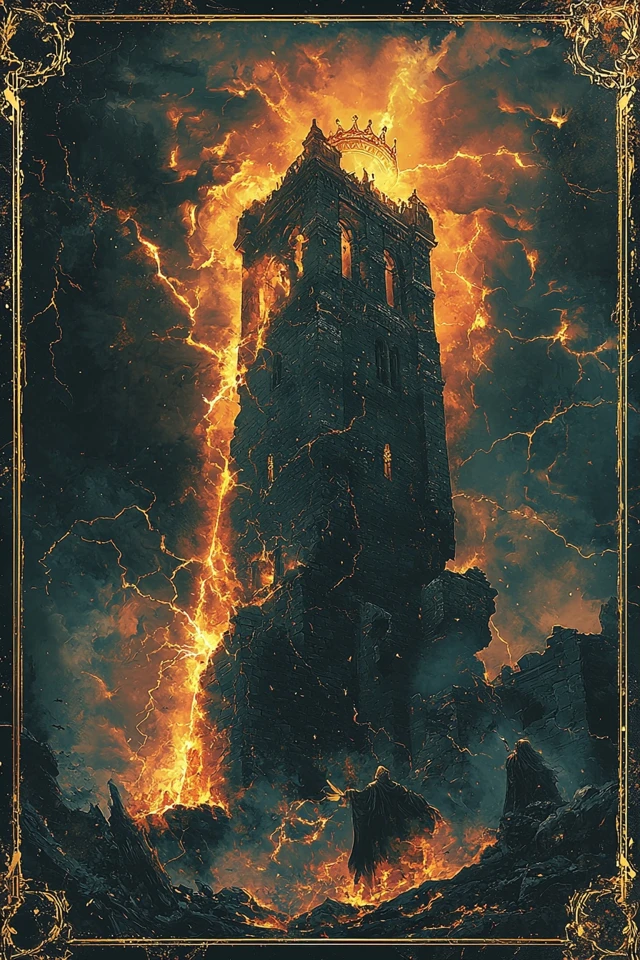
Innocence meets consequence — or wreckage clears the way for a true beginning. The direction is the reading.
The Reading
The Fool and The Tower can be read two ways, and reading them in the wrong order is one of the most common mistakes in tarot. If The Fool comes first, the pair describes naivety walking confidently towards a structure that is about to fail — the unexamined leap, the assumption that nothing could go wrong, the cliff the figure does not notice because they are looking at the horizon. If The Tower comes first, the pair describes a collapse that has cleared the ground for a true fresh start, with a lightness and willingness to begin again that the previous life would not have permitted. Same two cards, different readings, opposite messages.
What makes this pair distinct from Tower alone is the role of innocence in the reading. Tower in isolation is shock; Tower with The Fool is shock in conversation with beginnership. The querent is either too new to see the shock coming or, alternatively, has been freshly returned to a beginner state by a shock they did not survive on their own terms. A good reader notices which way the conversation is running. The clue is usually in the question. "Should I take this leap?" pulls the warning reading. "What now?" pulls the fresh-start reading.
In practice the pair shows up around impulsive decisions that go wrong in instructive ways, sudden quitting after a long stretch of structured life, the move to a new country that triggers an identity crisis, the marriage entered against advice that ends in dramatic divorce — and also around the lightness that follows a collapse, the joy of starting over with nothing to defend, the curious freedom of having lost so much that fear of losing more has temporarily lifted. Both readings are real. The skill is hearing which one the querent is actually living.
The shadow form depends on direction. In the warning reading, the shadow is the leap taken anyway, against all signals, in the belief that enthusiasm is the same as preparation. The querent walks confidently into the predictable collapse and then frames it as bad luck rather than as the consequence of refusing to look. In the fresh-start reading, the shadow is treating the post-collapse lightness as permanent — making major decisions in the giddy phase of having lost the previous structure, marrying the wrong person in the freedom of having left the right one. Both shadows share a feature: pretending that no consequence applies.
This pair misleads when the reader does not check direction. Pulled for a querent contemplating a leap, it usually carries warning weight — the Tower is forecast. Pulled for a querent in active recovery from collapse, it carries beginning weight — the Tower is past and The Fool is now. The same two cards mean almost opposite things in the two readings, and a reader who treats the pair as a single message will give half their clients the wrong advice. Always ask where in the arc the querent currently sits. The cards do not tell you; the question does.
If The Star or Ace of Pentacles appears alongside, the fresh-start reading dominates — the leap or the recovery is well-resourced and likely to land. If The Moon or Seven of Cups sits nearby, the warning reading dominates — the querent is leaping blind and the collapse is being underestimated. If Death appears, the previous chapter is fully closed and the beginning is real rather than illusory; this strengthens the fresh-start direction.
A working reader names the ambiguity explicitly. "This pair has two readings — which one applies depends on where you actually are." That move builds trust and prevents the client from receiving the wrong half of the message. The question that disambiguates is "has the collapse already happened, or are you about to take a leap?" Most querents know the answer immediately, and the reading flows from there. Do not pretend the pair has a single fixed meaning. Pretending costs you credibility and costs the client the reading they actually came for.
In love this pair is either the impulsive new relationship that is about to collide with reality, or the lightness of beginning again after a marriage has ended — and the freshness of being able to date as a more honest version of yourself. Direction determines tone. Read the timing of the question.
Career-wise the pair lands around the leap into a new venture or field — sometimes well-prepared and exhilarating, sometimes underprepared and about to teach an expensive lesson. Also around the fresh start after a public failure, where reputation is no longer the constraint it was. Both are real outcomes; both require honest reading of where the querent is in the arc.
Spiritually this is either the unexamined enthusiasm about to meet its first real test — the new practice, teacher, or path encountered with no defences — or the genuine beginnership that returns after a faith has collapsed and a different one is being approached without the old armour. Both are valuable; the second is rarer and almost always healthier than it looks.

Frequently Asked Questions
Possibly, but not automatically. The pair carries warning weight when the leap is being made without examination — when you have not stress-tested the plan, do not have a fallback, and are operating primarily on enthusiasm. If you have done the work, the same pair often becomes encouraging, with the Tower describing the collapse of the previous structure that made the leap necessary rather than the future collapse of the new one. Ask yourself honestly what you have not looked at. If something comes to mind quickly, the pair is asking you to look at it before leaping.
Yes, and the start is more genuine than most fresh starts. The Fool after the Tower has a quality that pre-Tower Fool does not — it has been seasoned by loss, knows what fragility feels like, and tends to make better choices in the first year than people imagine. The lightness you may be feeling is not delusion or shock. It is the recovery of beginnership, which is one of the genuine gifts of having been broken open. Trust it carefully. The first year is real start; year two is when the more durable structure begins to form.
Ask one question: has the precipitating event already happened? If you are deciding whether to take an action — quit, leave, move, marry — and it has not yet occurred, the pair is in the warning register and the Tower is forecast. If the action has occurred and you are in the aftermath, the pair is in the fresh-start register and the Tower is past. Clients sometimes resist the warning reading because they are committed to the leap. Resistance is data. If the pair feels wrong, that is often because it is hitting the leap-warning angle accurately.
Sometimes — but rarely in the form originally planned. Clients who leap against the warning reading often arrive at a workable outcome through a longer and more expensive route, with the eventual destination different from the one they imagined. The Tower part of the pair tends to deliver the lesson regardless of whether it is heeded; whether the lesson is paid for in months or in years depends on whether the warning was received. Honouring the warning is not abandoning the leap. It is preparing for it properly before taking it.
The pair often describes exactly that, and the direction depends on motivation. If you are moving towards something — a real opportunity, a genuine calling, a relationship that needed the move — the fresh-start reading applies and the Tower is the previous life closing behind you. If you are moving away from something — escaping conflict, debt, reputation, yourself — the warning reading applies and the Tower is the structure you have not actually escaped, which will reappear in the new location wearing different clothes. Run that test honestly before booking the flight.
Use the Tarot Combination Calculator to discover what any two cards mean together.
✦ Open Calculator