
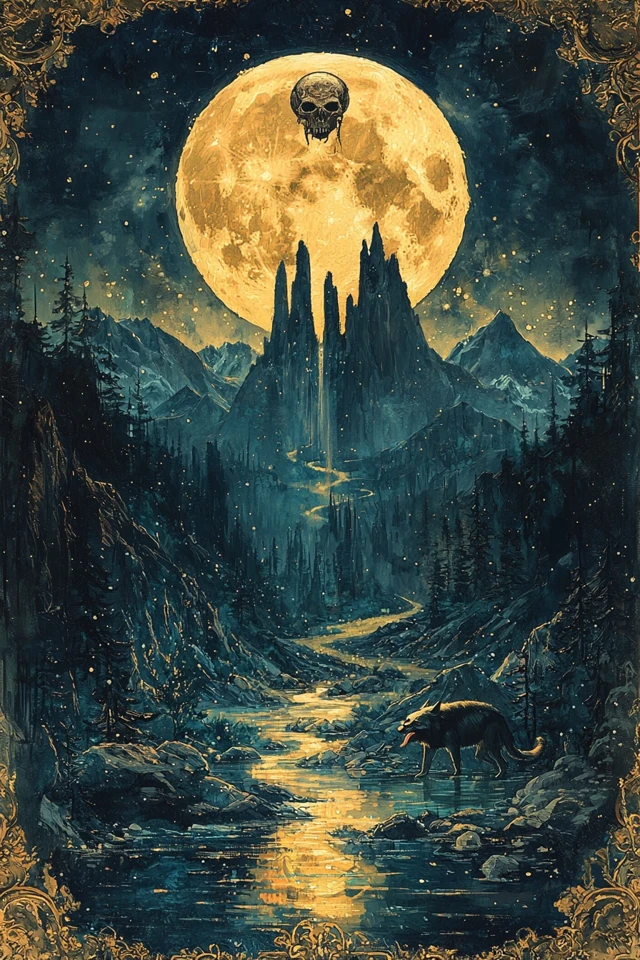
A solitary descent into material the daylight self was not equipped to face.
The Reading
The Hermit and The Moon together describe the long inward season — the months where the querent stops being able to participate in normal social rhythm because something underneath is asking for full attention. It is the pair of the dark night of the soul, the post-bereavement winter, the depth phase of therapy, the silent retreat that started as a week and turned into a re-evaluation of everything. The Hermit is not depressed in the clinical sense, but the boundary is thin; readers should ask honestly whether the querent is choosing solitude or being collapsed into it.
Unlike Hermit alone, which is contemplative and steady, the Moon's presence means the material being worked is not yet in language. Dreams intensify. Old memories surface uninvited. The body asks for things — sleep, salt, water, weeping — that the calendar does not have time for. People in this pairing often describe feeling slightly mad and slightly more sane than they have been in years, simultaneously. Both are accurate. The ordinary self is being temporarily set aside so the older, slower self can do some required work.
The practical question with this combination is not how to get out of it, but how to honour it without losing function. A small daily rhythm — one walk, one meal cooked, one person checked in with weekly — tends to be enough to keep the descent productive rather than dissolving. Readers should warn against major decisions during this phase. The clarity that arrives at the end is real; the clarity that arrives in the middle is usually a hallucination of clarity produced by exhaustion. Wait until the lamp is steady again.
The shadow is isolation mistaken for wisdom. The Hermit's lamp goes out and the querent keeps walking, telling themselves the dark is the lesson. Friends stop reaching; the querent does not notice or claims to prefer it. Drinking, doom-scrolling, late nights and reversed sleep schedules become the texture of the "spiritual work". The Moon's distortion field makes self-pity feel like depth and avoidance feel like discernment. The corrective is one trusted human kept in regular contact — not to pull the querent out of the descent, but to confirm that they are still in their own body and not entirely inside the dream.
Read with care when the querent shows signs of clinical depression, an active eating disorder, or recent grief without support. The romantic version of this pair — "the soul's deep night, beautifully borne" — is dangerous if applied to someone who needs a GP, a therapist, or both. The cards describe a real and sometimes necessary process, but the reader is not equipped to be the only witness to it. If the querent has not seen another human in a fortnight or cannot sleep at all, the reading is "please call your doctor", not "honour the descent".
If The Star, Temperance, or the 6 of Cups appears nearby, the descent has a healing trajectory and the querent is being slowly returned to themselves. If The Devil, 5 of Cups, or 8 of Swords appears alongside, the solitude has crystallised into something stuck and outside help is needed to break it.
Experienced readers treat this pair with quiet seriousness. They tend to ask three questions: when did you last sleep through the night, when did you last eat a real meal, and who knows where you are. The answers usually tell the reader whether the combination is functioning as legitimate inner work or as undiagnosed depression wearing a mystical costume. The cards are not the diagnosis; the answers to those three questions are. A skilled reader holds both possibilities at once without flinching.
In love this pair often describes a season of necessary withdrawal — from dating, from a partner, sometimes from one's own children for short hours of the day. It is not the end of relationships; it is the recovery of the self that the relationships will eventually be conducted by. Partners who can tolerate this season without taking it personally usually find the relationship stronger on the other side.
Career-wise the pair often arrives during a sabbatical, a burnout recovery, or an unstructured gap between roles. Decisions about the next job tend to be wrong if made during this phase. The work is to let the previous identity finish dissolving before reaching for a new shape. Anything reached for too soon tends to be a version of the thing that exhausted you.
Spiritually this is genuine deep work — the kind that does not photograph well. No retreat centre, no incense, no certificate at the end. Just the slow, mostly silent re-acquaintance with the parts of yourself that the productive years had to bury to keep moving. The reward is not enlightenment; it is being able to live in your own company again.


Frequently Asked Questions
In most cases the acute phase — the part where ordinary life feels distant and effortful — runs three to six months. A longer integration period of another six to nine months follows, in which you slowly rejoin normal rhythms with new internal furniture. If the acute phase passes the six-month mark without lightening at all, it is worth checking whether what you are calling a Hermit-Moon season has become depression that needs treatment.
Some withdrawal is correct; total withdrawal is not. Reduce social contact to the few people who can be with you without requiring performance. Keep one person who knows the rough state you are in and roughly where you are. Cancel the rest without guilt. The pair does not require monastic isolation — it requires the absence of audiences.
Often unusually so during this pairing. Keep a notebook by the bed and write down whatever fragments survive waking, in plain language rather than trying to interpret. Patterns emerge across two to three weeks that single dreams will not reveal. Resist the urge to assign mystical significance to every image. Most of what surfaces is old material being processed, not prophecy.
It can be either, and sometimes both, and the distinction matters. Genuine inner work, even when painful, tends to feel slow and oddly nourishing — sleep restores you, food tastes like something, you cry but you also feel relieved afterwards. Depression tends to feel flat — sleep does not restore, food has no taste, you cannot cry or you cannot stop, and nothing afterwards feels like relief. If the second description fits, please see a doctor regardless of what the cards say.
Yes, and usually in ways the pre-descent version of you would not have chosen and the post-descent version would not give back. People who have walked this combination consciously tend to describe the year after as the most honest year of their adult life. The change is rarely dramatic from the outside. From the inside it is total.
Use the Tarot Combination Calculator to discover what any two cards mean together.
✦ Open Calculator