
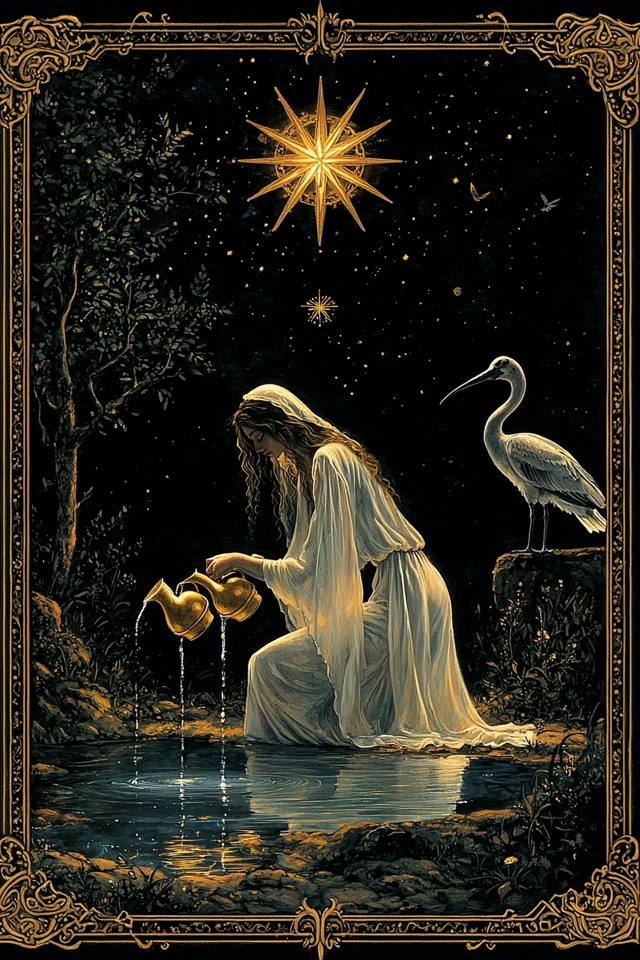
The slow return to yourself through being alone, on purpose, for long enough.
The Reading
The Hermit and The Star together describe the rebuilding year — not a retreat from life so much as a deliberate clearing of space in which the self can re-form. The Hermit provides the solitude; the Star provides the slow refilling. This is the pair that arrives around the post-divorce year, the recovery from burnout, the long sabbatical after a parent dies, the quiet twelve months after leaving a community that no longer fits. Unlike Hermit-Moon, the work is not descent. It is convalescence — a recovery that the previous life made impossible.
Readers see this pair in the querent who has finally stopped trying to optimise their solitude and started simply living in it. The dramatic phase is over; the boring, restorative phase has begun. Sleep starts working again. Small pleasures — light through a kitchen window, a particular tea, an unsupervised hour at a library — start being noticed rather than instrumentalised. The Star's gift here is not hope in the inspirational-poster sense; it is the older, plainer sense of being able to drink water and have it actually reach you.
Practically, this combination rewards being unbusy for longer than feels respectable. Querents often try to cut the phase short — accepting the new job at month three, beginning to date again at month four, taking on the new responsibility at month five — because being unproductive starts to feel shameful in a culture that does not understand convalescence. The cards are gently insistent: not yet. The Star is filling the well slowly. Drawing from it before it is full restarts the depletion. Give the year its full year. The version of you that emerges on the other side is the one that will choose better than the depleted version could have.
The shadow is solitude that has lost its purpose — the Hermit's lamp dims and the Star's water becomes melancholy rather than restoration. The querent stays in the recovery posture past the point where it is recovering anything, often because returning to ordinary life feels exposing after a long period of being unobserved. Months stretch into years; the convalescence becomes the identity. The corrective is small re-entries, deliberately scheduled: one dinner, one volunteer shift, one weekly class — not to end the solitude, but to confirm that the world is still there and the querent is still in their own body.
Read carefully when the querent's solitude is financially or socially unsustainable. The cards describe a luxurious-sounding process that not everyone has the conditions for. A querent who cannot afford to step back from work, or who has young children, or who is in an immigration situation that requires constant activity, is not failing the reading by being unable to retreat for a year. The pair can also describe small daily versions — one hour of solitude a day, one weekend a month — woven into a life that cannot pause. The texture matters more than the scale.
If The Sun, The World, or the 10 of Cups appears nearby, the convalescent year is ending and re-entry is approaching faster than the querent expects. If The Moon, 8 of Cups, or 4 of Cups appears alongside, the solitude is still doing real work and the querent should resist external pressure to re-emerge before the well is full.
Experienced readers protect this pair from being rushed. They tend to ask the querent what they are afraid will happen if the recovery lasts another six months — and the answer usually reveals the social or financial pressure that is trying to cut the process short. The reader's job is not to remove the pressure, which is often real, but to help the querent see that the pressure is external while the timeline is internal. Where possible, the reader advocates for the full duration. Where impossible, the reader helps design a smaller version that protects the essential quiet rather than abandoning it entirely.
In love this pair almost always recommends not yet. New relationships started during the recovery phase tend to inherit the depletion the recovery is meant to undo. The work is to become someone who can choose a partner from fullness rather than need. Existing relationships, where they remain, tend to deepen quietly during this period if the partner can tolerate reduced availability without taking it personally.
Career-wise the pair often describes the gap year between a role that exhausted you and the next role, which has not yet appeared. Resist the urge to take the first acceptable offer. The Star is preparing you to recognise the right shape; the Hermit is keeping you out of premature commitments. The job that arrives at month eleven tends to be substantially better than the one that would have arrived at month four.
Spiritually this is the simplest, most healing combination in the deck. No drama, no descent — just the slow re-acquaintance with what it feels like to be a person rather than a function. The work is to do less and trust that doing less is, this year, the work.

Frequently Asked Questions
Small signs accumulate. You start being curious about other people again without it feeling effortful. You imagine projects without being immediately tired. You notice an absence of the old depletion when you wake up. The shift is rarely a single moment; it is a gradual increase in available energy that becomes obvious in retrospect around month ten or eleven. When you find yourself spontaneously wanting to take something on, rather than feeling you should, the phase is ending.
Generally not in the first six months, and only carefully thereafter. The Hermit-Star pair is asking you to become reacquainted with yourself before you re-pattern around someone new. Dating during the active recovery often produces relationships that look like progress but turn out to be the old pattern in fresh clothes. If you do begin to date, treat the first few experiences as information-gathering, not partner-finding.
Most people cannot, and the cards are not actually asking for a year off work — they are asking for a year of protected interior space, which can be built inside an ordinary working life. One hour of solitude a day, one unscheduled day a week, and a refusal of optional commitments for twelve months together produce most of the same effect as a full sabbatical. The shape matters more than the scale.
Some yes, and the ones you lose tend to be the ones that were maintained by performance rather than connection. The friendships that survive a quiet year — even if the contact thins to occasional texts — are the ones worth keeping. Most querents find on the far side that their social circle is smaller and substantially more nourishing. The loss feels frightening in the middle and turns out to have been pruning.
Yes, almost universally, and the guilt is usually misplaced. It tends to be the residue of a culture that treats unproductive time as suspicious, especially for women, eldest children, and people from immigrant or working-class backgrounds. The guilt is not a signal that you are doing the wrong thing. It is a signal that you were trained to keep moving regardless of cost. Feel the guilt, do not act on it, and continue resting. The training fades by about month seven.
Use the Tarot Combination Calculator to discover what any two cards mean together.
✦ Open Calculator