
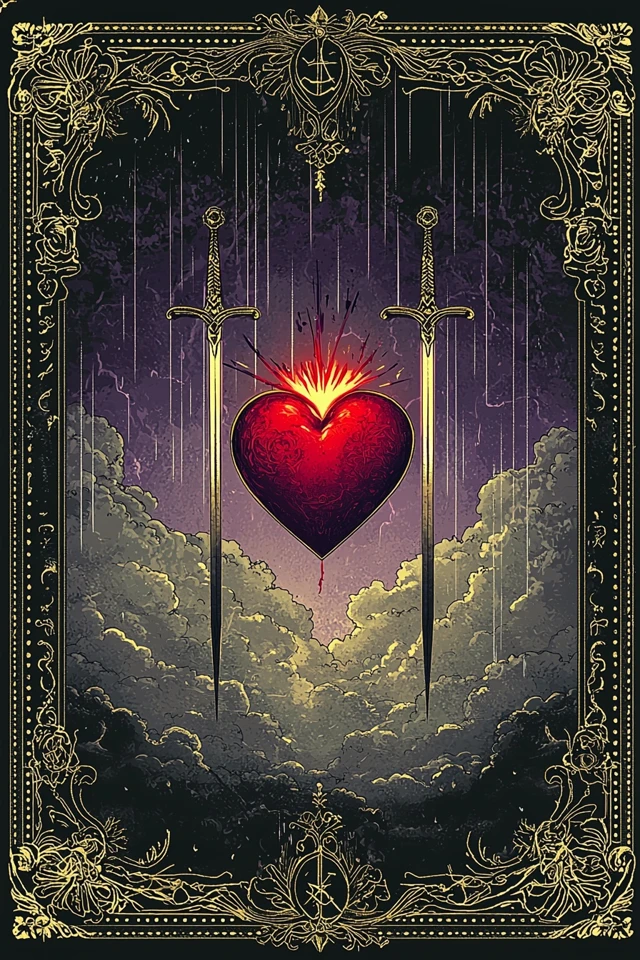
Heartbreak inside a specific relationship — affair, betrayal, the conversation that changes everything.
The Reading
The Lovers and Three of Swords together describe heartbreak that has a name and an address. This is not general grief; this is a specific relationship and a specific wound. The Lovers is the bond as it was; the Three of Swords is the cut through it. The pair appears for affair discovery, the moment a partner says something that cannot be unsaid, the realisation that the version of the relationship you have been living is not the version your partner has been living, and the slower forms of betrayal — the loyalty given to someone or something at your expense, the lie that has been running for longer than you knew. The combination is specific. The querent usually knows exactly which event the cards are referring to, even before the reader speaks.
What makes this pair difficult to read is that it does not necessarily mean the relationship is over. The Three of Swords is honest about the wound without prescribing what happens next. Some relationships survive what this pair describes and end up stronger, having renegotiated everything. Others end here. The decision belongs to the two people in it and is rarely made cleanly in the first month after the wound is exposed. The cards are accurate about the pain. They are deliberately unspecific about the outcome.
The pair often appears in two contexts. In one, the wound is fresh — days or weeks old — and the querent is reading to make sense of what just happened. In the other, the wound is months or years old, the relationship has continued in a quiet damaged form, and the cards are saying the wound has not actually been processed. Both versions need different readings. Fresh wounds need orientation; old wounds need to be named as old and to be worked through, often with help the cards cannot provide. Tarot is not a substitute for the conversation; it is what helps the querent find the conversation.
The shadow form is the wound that becomes the identity. The querent stays in the relationship — or leaves it — but the betrayal becomes the lens through which every subsequent interaction is read. New partners are tested for it; the original partner is punished for it years after either reconciliation or parting; the heart organises itself around the cut. The Lovers fades because the querent has stopped being able to recognise love that is not also threat. Readers seeing this pattern should name it gently. Living from a wound is understandable; the cards are showing that it has now cost more than the wound itself.
Occasionally the pair appears for a relationship the querent has been protecting from a truth about it for a long time — not a single betrayal but a slow accumulated honesty the relationship has been unable to hold. When that is the case, the Three of Swords is more recognition than event. There is no specific affair, no specific lie; there is simply a long quiet pain the querent has finally let themselves see. Read this version with care. It is less dramatic and often harder to act on than a discrete betrayal.
If Tower or Devil appears alongside, the betrayal is structural and the relationship is unlikely to survive in its current form. If Star or Temperance appears, repair is on the available path. If Justice appears, what has been hidden will come to formal light — either through confrontation, exposure, or legal process.
Experienced readers do not predict the outcome of this pair in the first reading. They name the wound, hold space for it, and refuse to either rush reconciliation or rush departure. Clients pulling this pair are usually in shock and the most damaging thing a reader can do is tell them what to decide. What helps is precision — name the dynamic, separate fact from suspicion, identify the actual question (is it about whether to stay, whether to confront, whether to forgive, whether to leave well). Most clients conflate all of these into one impossible question. Untangling them is the work.
A specific wound has happened or is being recognised inside the relationship. The pair does not tell you whether to stay or leave; it confirms the wound is real and that the relationship cannot return to its pre-wound version. What it becomes from here is decided in the months following, often slowly. Do not rush a binding decision in the first weeks.
In career contexts the pair often describes professional betrayal — a colleague who took credit, a mentor whose loyalty was conditional, a partnership broken by someone's private agenda. Document what happened, name it accurately, and resist the urge either to immediately retaliate or to pretend it did not happen. Both responses extend the wound.
Spiritually the pair asks what your heart was loyal to that allowed the wound to be possible. Often it is a story about love that required your eyes closed in particular places. The work is not to harden against love; it is to keep loving without the blindness the previous version required.

Frequently Asked Questions
No, but it is one of its common forms. The pair describes heartbreak inside a specific relationship, which includes infidelity, emotional affairs, betrayal of trust around money or family, a partner choosing someone else (a parent, a child, a friend) over you in a damaging way, or a long lie that has finally come to light. The constant is a wound between two specific people, not always sexual betrayal.
The cards do not decide that for you, and any reader who tells you what to do is overstepping. What helps is naming what you actually want from the conversation. If you want the relationship to have a chance of repairing, the conversation eventually has to happen. If you are gathering information to leave well, the timing of the conversation matters differently. Be honest with yourself about which one you are doing before you speak.
Sometimes. Relationships that survive what this pair describes usually do so because both people are willing to do extended work — often professional, often painful — to rebuild the trust from a new foundation. The relationships that pretend the wound did not happen tend to carry the damage forward rather than heal it. Survival is possible; pretending is not.
The acute phase usually lasts three to six months. After that, the pain integrates rather than disappearing — it becomes part of what you know about the relationship and about yourself, rather than the central fact of every day. People who actively process the wound, with friends or therapy, tend to integrate it in roughly a year. People who do not tend to carry it for much longer.
Yes, and this is one of the more common outcomes the cards do not name explicitly. Forgiveness — the slow release of the wound as a present-tense weight — does not require reconciliation. Many people who leave under this pair eventually forgive without returning. The two decisions are separate, even though they often get conflated in early grief.
Use the Tarot Combination Calculator to discover what any two cards mean together.
✦ Open Calculator