Five of Swords
Five of Swords says no — winning at all costs damages what matters most. Choose integrity over victory.
Upright Meaning
The Five of Swords warns of a hollow victory — you may win the battle but lose something far more important. Ego-driven conflict creates lasting damage. Is this fight truly worth the cost?
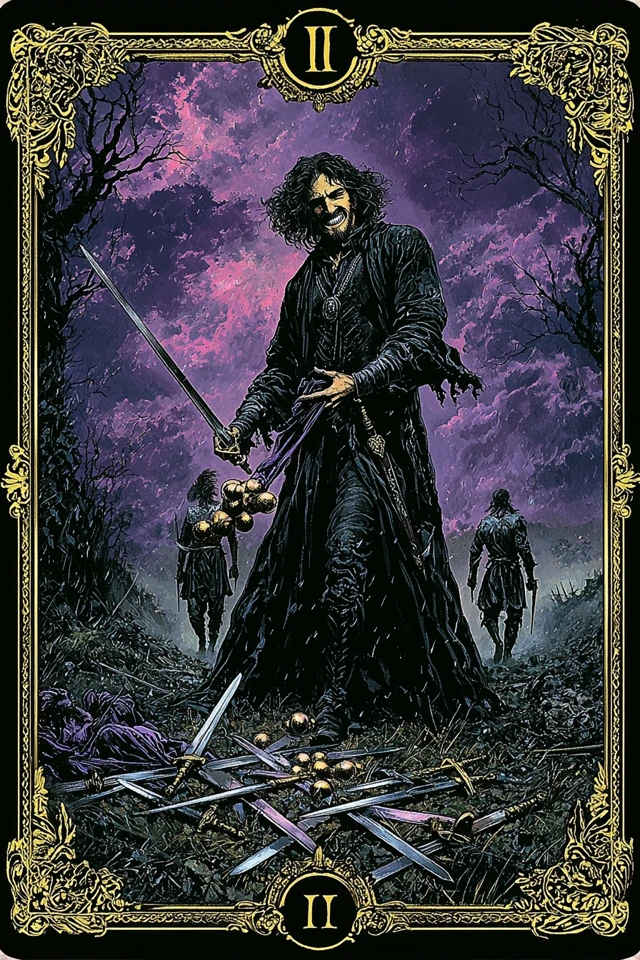
The Five of Swords is one of the most uncomfortable cards in the tarot precisely because it forces us to examine our own role in conflict. The figure in the traditional image picks up the swords of defeated opponents — but look at their faces. The victory is hollow. Something important has been lost or broken in the pursuit of winning. This card shows up when the ego has taken the wheel: when being right has become more important than being kind, when protecting pride has cost something of genuine value. It asks the hardest question: was the fight worth it? And more importantly — is it still worth it? The Five of Swords never suggests that you should be a doormat, but it does insist that not every battle deserves your energy.
Reversed Meaning
Full Reversed Page →A conflict is resolving, or you are recognising the cost of a previous battle and seeking reconciliation.
The Five of Swords reversed carries a more hopeful message than its upright position. Conflict is either ending or you are reaching a point of genuine readiness to move beyond it. There may be an acknowledgement of the damage caused — by yourself or by others — and a desire for reconciliation. However, reversal can also indicate that unresolved guilt or regret is lingering, making it difficult to truly move forward. Old wounds from past battles may be re-emerging. The invitation here is not to re-fight old wars but to genuinely process what happened and choose a different response next time.
A destructive argument, manipulation or someone winning at the expense of the relationship.
Office politics, sabotage or a situation where someone is playing dirty.
Choosing ego over integrity always comes at a spiritual cost. True victory requires honour.
Five of Swords in Love — Full Meaning
The Five of Swords in love is the card of conflict, and specifically of the kind of conflict where winning costs more than losing would have. An argument has happened, or is happening, and someone is determined to be right. Pride has taken the wheel. Cutting words have been used. The other person may have walked away — physically, emotionally, or both — leaving the victor standing alone among the dropped swords, wondering whether the point that was defended was actually worth what defending it has just cost.
This card sometimes describes a relationship that has become hostile in subtler ways: small daily disagreements where each person is keeping score, sarcasm that pretends to be humour, the constant low pressure of someone trying to come out on top. That climate erodes love faster than almost anything else. The Five of Swords names it honestly so it can be addressed before more damage is done.
The growth edge is the willingness to ask whether being right is what you actually want here. Often the honest answer is no — what you want is to be heard, or respected, or to stop feeling small in the relationship. Those needs deserve to be named, but they cannot be met by winning arguments. Step out of the fight long enough to see what you are really fighting for. If you owe an apology, give it cleanly, without bundling in a counter-grievance. If the other person is the one with the sword raised, decide what you are willing to keep absorbing. The Five of Swords does not always advise leaving, but it asks you to stop pretending that this dynamic is sustainable. Pride is heavy. Put it down and see what the relationship looks like underneath.
In love, the Five of Swords reversed often marks a turning point in a difficult relationship dynamic. Arguments that escalated beyond reason may begin to settle, and both partners may recognise that the damage done to trust is a serious concern. This card reversed calls for honest conversation rather than score-keeping — a genuine effort to repair rather than retaliate. If the relationship has been characterised by one partner consistently winning arguments while the other loses dignity, the reversed Five of Swords signals that this pattern must change or the relationship cannot survive.
In career readings, the Five of Swords reversed can indicate the aftermath of workplace conflict — a resolution, however uncomfortable, beginning to take shape. Office politics or competitive dynamics that have been playing out may be losing their intensity. This is an opportunity to rebuild professional relationships damaged by power struggles. Alternatively, it can suggest finally choosing to walk away from a toxic work environment — accepting the short-term discomfort of a career change over the long-term damage of remaining in a place of constant conflict.
Spiritually, the Five of Swords reversed is a powerful invitation to examine the ego's role in your life. Conflict — whether external or internal — is one of the ego's favourite territories. The reversed card asks: what in you still needs to win, to be right, to dominate? True spiritual maturity is not about never feeling competitive or defensive, but about recognising those impulses and choosing a response aligned with your deeper values. Forgiveness — of others and of yourself for past battles — is the primary spiritual work of this card.
Frequently Asked Questions
The Five of Swords represents conflict, hollow victory and the cost of ego-driven behaviour. It warns that winning at all costs can destroy what matters most — relationships, reputation and self-respect. In a reading, it signals a need to choose battles wisely and consider whether the pursuit of victory is truly worth the price being paid.
No — the Five of Swords is generally a no card, particularly for questions involving conflict, competition or aggressive tactics. It cautions that forcing an outcome through power or manipulation will lead to a hollow result. Reversed, the answer softens: not yet, but healing and resolution are becoming possible.
In love, the Five of Swords is a warning sign. It often indicates arguments where someone is more focused on winning than on the health of the relationship, or a dynamic of manipulation, betrayal or disrespect. It calls for an honest assessment of whether the relationship brings out the best or worst in both partners.
It marks conflict, particularly the kind where pride has taken over and someone is determined to win regardless of cost. The card describes hollow victories — being right at the expense of the connection, scoring points that leave the relationship weaker, hostility that has crept into the daily climate. It asks you to look honestly at what you are actually defending. Often beneath the position there is a real need — to be heard, respected, or treated more gently — that cannot be met by winning the argument. Name the underlying need instead. The fight is rarely about what it appears to be about.
Yes, and it is worth taking seriously. The card warns that the current pattern of conflict is corrosive and that continuing it will cost more than either of you currently sees. It is not predicting the end of the relationship; it is showing the dynamic that will end it if unaddressed. Take the warning as useful information rather than doom. The path forward involves at least one of you setting down the sword first — not as surrender but as a refusal to keep fighting on these terms. The longer the climate of hostility runs, the harder repair becomes.
It often accompanies endings, especially the kind that arrive through accumulated conflict rather than a single decisive event. If the relationship is ending under this card, try to end it cleanly. The temptation will be to fire one last cutting truth on the way out, to make sure they know exactly what you think. Resist it. Endings handled with dignity heal faster than endings won. You will carry whatever you said last for longer than you imagine. Say the things that need saying, but say them without the urge to wound. Walk away whole rather than triumphant.
They are likely feeling defensive, wounded, or oriented toward winning rather than toward the connection right now. Something has activated their pride, and they are not currently able to meet you in a soft place. This is rarely permanent — the Five of Swords is a phase rather than a verdict — but it does describe their current state. Pushing for resolution while they are in this mode tends to escalate rather than help. Give some space. When you do return to the conversation, lead with what you got wrong rather than what they did. That move often unlocks more than another round of arguing the case.
Often appears with






Other 5s — the same number, a different suit

Same element — Air






More from the Swords



Popular Combinations with Five of Swords
See how Five of Swords interacts with other major arcana cards in a reading.