Four of Swords
Four of Swords says not yet — rest is required before any meaningful action can be taken.
Upright Meaning
The Four of Swords commands you to stop and rest. Your mind and body need recovery time before the next challenge. This is not defeat — it is the wisdom to know that action without rest leads to collapse.
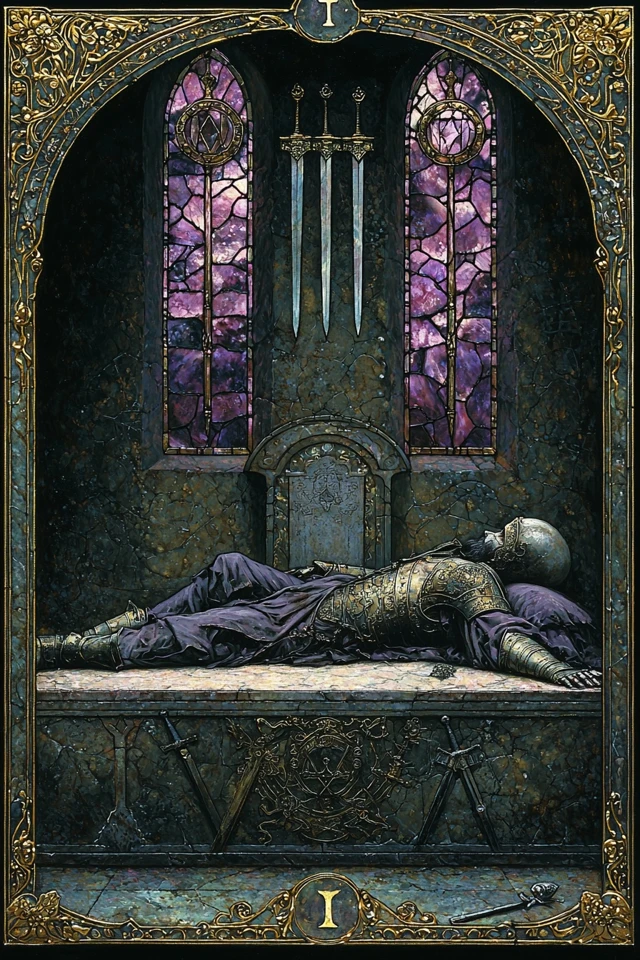
The Four of Swords depicts a knight in repose — lying still, hands folded, three swords mounted on the wall above while a fourth rests beneath him. This is not defeat but deliberate withdrawal. The figure is not dead but resting, and the distinction matters enormously. After the sharp pain of the Three of Swords, the Four offers the radical proposition that stillness is not laziness but strategy. The mind that has been working hard, fighting battles, or absorbing difficult truths needs time to integrate, recover, and consolidate. This card appears when the most productive thing you can do is stop producing — when rest is not a gap between meaningful activities but a meaningful activity in itself. The church setting in many traditional depictions adds a contemplative quality: this is not mere sleep but a kind of sanctuary, a space apart from the world's noise where inner resources can quietly replenish. The Four of Swords gives permission to pause without guilt.
Reversed Meaning
Full Reversed Page →Restlessness, inability to truly rest, or beginning to slowly re-emerge after a period of recuperation.
Reversed, the Four of Swords suggests that either rest has gone on too long and stagnation has set in, or that necessary rest keeps being refused. In the first case, a period of recovery has become avoidance: the withdrawal that was once restorative has hardened into isolation or inertia, and the time to re-engage is overdue. In the second case, someone is pushing through exhaustion, anxiety, or burnout when what they most need is to stop. The body and mind have a wisdom that ignores signals at its peril, and this reversal often appears when that wisdom is being overridden by obligation, fear, or the inability to give oneself permission to rest. It can also indicate a restless, anxious quality to sleep or inner life — the mind unable to settle even when the body is still. The invitation is always the same: discern whether you need to return to action or finally grant yourself stillness.
A needed break from relationship intensity. Space and quiet restore what urgency drains.
Take a break before burnout forces one on you. Strategic retreat now prevents collapse later.
Meditation, silence and retreat are essential medicine for your soul right now.
Four of Swords in Love — Full Meaning
The Four of Swords in love is the call to rest. Something in your romantic life has been demanding — a difficult breakup, a long stretch of dating that drained more than it gave, a relationship going through a hard season — and the card is telling you to stop pushing for a moment and let yourself recover. This is not the same as giving up. It is the deliberate, healing pause that makes everything else possible afterward.
For singles, the card often counsels a deliberate withdrawal from dating apps, from the search, from the pressure to keep producing romantic effort while your reserves are empty. Trying to meet someone while exhausted and unhealed rarely brings in the person you actually want; it brings in whoever fits the shape of your current depletion. Step back. Do the dull, unglamorous work of resting properly. The right re-entry will come on its own once you are no longer running on fumes.
For couples, the Four of Swords can mark a quieter phase where the relationship needs less intensity and more peace. After a difficult patch, this might look like deliberately calm evenings, fewer hard conversations for a little while, more practical care and less analysis. It is not stagnation. It is the convalescence period that lets the connection knit back together. The growth edge here is to trust that rest is doing real work even when nothing appears to be happening on the surface. Do not interrupt the recovery with new dramas. Honour the quiet. The card is reminding you that the strongest love lives need genuine pauses, and that the pause you take now will pay back generously once you are ready to re-engage.
In relationships, a reversed Four of Swords may indicate that one or both partners need space to recover from a period of intensity or conflict, but that space is not being honoured. Alternatively, a withdrawal that began as healthy distance has calcified into disconnection. There is also a gentle message here for anyone emerging from a painful relationship: rest is part of the healing, and re-engaging before you are ready rarely serves you or a new partner well.
At work, this reversal often signals burnout that is being denied or a workaholic pace that cannot be sustained. If you have been running on empty, the warning is worth heeding: rest neglected now tends to demand repayment later, at considerably higher cost. On the other hand, if your hiatus has extended further than originally intended, this reversal may be the gentle nudge to begin re-engaging — slowly, but genuinely.
Spiritually, the reversed Four of Swords highlights the relationship between stillness and spiritual renewal. When the practice of quiet — meditation, prayer, contemplation — is neglected, the inner life becomes increasingly reactive and surface-level. Conversely, if spiritual retreat has become a way of avoiding ordinary life, the reversal asks you to bring what you have gathered in stillness back into the world where it can be of use.
Frequently Asked Questions
The Four of Swords is a card of rest, recovery, and deliberate retreat. It appears after periods of mental strain, conflict, or intense activity to suggest that the most intelligent next step is to stop and allow recovery. It is not a card of defeat or stagnation but of strategic withdrawal — the understanding that sustainable effort requires recuperation. In practical terms, it may suggest taking a holiday, reducing commitments, stepping back from a conflict to gain perspective, or simply allowing yourself adequate sleep and quiet. The Four of Swords treats rest not as a luxury but as a necessity for continued functioning.
Generally, yes — particularly if you are in a period of stress, overwork, or recovery. The Four of Swords brings a welcome message: you are allowed to rest, and doing so is wise rather than weak. The card is positive in its trust that stepping back does not mean falling behind. However, context matters: if you have been resting for an extended period and the question is about moving forward, the Four of Swords might suggest that continued retreat is no longer serving you. Its positivity is situational — it is most helpful when rest is genuinely what is needed.
In questions touching on mental health and wellbeing, the Four of Swords is one of the more encouraging cards to receive. It validates the need for mental rest and recovery — for stepping away from sources of stress, reducing cognitive load, and creating space for the nervous system to settle. It suggests that healing from anxiety, burnout, grief, or mental exhaustion is genuinely possible, but requires time and intentional quiet rather than pushing through. The card encourages compassionate pacing: you cannot think your way out of a depleted mind; you have to allow it to restore. Professional support alongside genuine rest is always a worthwhile combination.
It is the card of rest and recovery in a romantic context. Something has been demanding — a breakup, a draining dating phase, a hard chapter in a relationship — and the card is telling you to pause and let yourself heal. For singles this often means stepping back from active pursuit. For couples it can mean a deliberately quieter phase with less intensity and more practical care. The pause is not stagnation; it is the work that makes everything afterward possible. Trust that genuine rest is doing its job even when nothing dramatic appears on the surface.
It is a wise card rather than an exciting one. The Four of Swords does not bring fireworks; it brings the steadying breath you have been postponing. For anyone tired, hurt, or recently come through something heavy, this is genuinely good news. The card honours what you have been carrying and gives you permission to set it down for a while. Couples find it strengthening in the longer view: a relationship that learns to rest together becomes more durable than one constantly chasing intensity. Take the slower pace seriously. It is not a delay; it is the foundation for what follows.
It is one of the most supportive cards you can draw at this stage. The Four of Swords confirms that what you need now is genuine rest, not more processing, not more analysing, not another conversation about what went wrong. Cancel the optional commitments. Sleep more. Take walks. Let trusted people be near without asking them to fix anything. Healing happens in the dull, repeated days of letting your nervous system settle. Resist the urge to date your way out of the grief. The card promises that the recovery you give yourself now will return strength when you are ready to open again.
It often advises a deliberate, chosen period of stepping back from the search. Not forever — just for long enough to remember who you are without the dating noise. Delete the apps for a while if they have been draining you. Spend the time on rest, friendship, and the parts of your life that have been quietly neglected while you were trying to meet someone. The Four of Swords promises that the right re-entry will come more easily from a rested place than from a frantic one. Singleness here is not a problem to solve; it is a window to honour.
Often appears with

Other 4s — the same number, a different suit


Same element — Air




More from the Swords

Popular Combinations with Four of Swords
See how Four of Swords interacts with other major arcana cards in a reading.