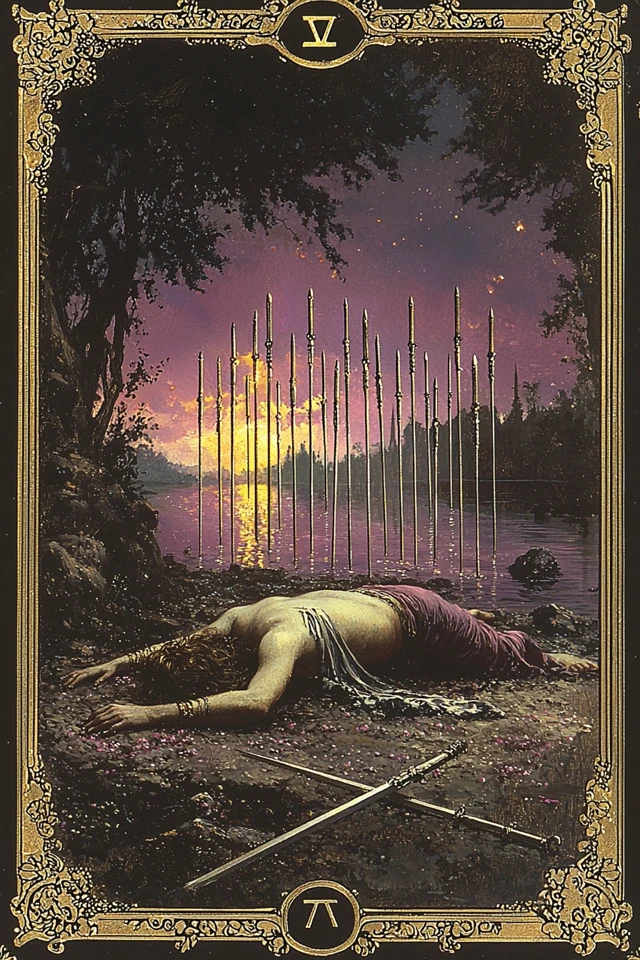
Ten of Swords Reversed
A reversed card is not a flipped-meaning card. Ten of Swords reversed asks you to look at the same energies as the upright version, but from a less comfortable angle — where the qualities are blocked, exaggerated, withheld, or expressed in shadow form. Most often, the reversal is more useful than the upright reading, because it points to something internal that you can actually change.
Ten of Swords Reversed — Meaning
A very slow or partial recovery, or resisting an ending that has already effectively occurred.
Reversed, the Ten of Swords suggests a process of recovery in the aftermath of a significant ending or blow. The acute phase is over; now comes the slow, unglamorous work of rebuilding. However, the reversal can also indicate a resistance to accepting that something is truly over — a refusal to let a situation reach its necessary conclusion, even when prolonging it only extends suffering. There may be a tendency to catastrophise: to experience difficulties as definitive endings when they are actually setbacks that can be recovered from. Conversely, if you have genuinely been through something terrible, the reversal is a gentle reminder that the rock bottom has been reached, the worst is behind you, and the direction — even if the progress is slow — is now upward.
❤️ Ten of Swords Reversed in Love
The Ten of Swords reversed in love is delicate territory. Sometimes it shows slow recovery from a relationship ending that has already happened — the worst is genuinely behind you, dawn is breaking in the background of the card, and life is gradually returning. The pain is no longer fresh. You can think about what was lost without being completely undone by it.
The other reading is harder. Sometimes the reversed Ten shows refusal to acknowledge what is clearly over. The relationship has ended in every meaningful way — the connection, the trust, the future — and yet you are still treating it as ongoing, still hoping for a return that the situation will not give you. The card reversed asks gently whether you are recovering or whether you are holding the body of something that has already left. Both can feel similar from inside. The difference matters.
Be honest with yourself about which version you are in. If you are recovering, the work is patience and tending: let the dawn come at its own pace, accept help, do not test yourself prematurely with reminders of the loss. If you are denying, the work is harder but kinder in the long run: let yourself name that it is over, let the grief actually begin rather than postpone it indefinitely, let the next chapter become possible. The Ten of Swords reversed in love does not condemn either response. It simply asks you to know which one is yours, and to act with the honesty the moment requires.
💼 Ten of Swords Reversed in Career
The Ten of Swords reversed at work usually marks slow recovery from a professional collapse — a redundancy, a failed venture, a public mistake, a betrayal by someone you trusted. The crisis itself is behind you. The integration is the work now. You may still feel raw, still rehearse what happened, still wonder if your reputation will recover — and all of that is normal at this stage. The dawn is real even when you cannot yet feel its warmth.
Take the recovery seriously. The temptation to rush back to full capacity — to prove you are unbroken, to outrun the story by working twice as hard at the next thing — almost always recreates the conditions that broke you. Slow is the speed that lasts. Choose your next move from a place of recovered ground rather than from the urge to escape what just happened. The right opportunity will wait for you to be ready for it.
The harder reading: refusing to acknowledge that something is genuinely over. The role you have been clinging to. The project everyone else has stopped believing in. The professional identity that is no longer accurate to what you actually do or want. The Ten of Swords reversed at work asks whether you are recovering from an ending or postponing one. If it is the latter, the kindest thing you can do for yourself is to let the ending be real. The new chapter cannot start while you are still standing in the ruins of the old one pretending the roof is intact.
🌿 Ten of Swords Reversed Spiritually
The Ten of Swords reversed spiritually is the slow dawn after the death of an old self. Something major has ended — a belief system, an identity, a way of being in the world — and you are in the tender phase where the old structure is gone and the new one has not yet formed. The card reversed honours this in-between. It is not failure. It is the necessary fallow ground.
This stage cannot be rushed. The instinct to immediately construct a new spiritual identity — a new framework, a new label, a new certainty — is the ego trying to plug the hole the old one left. The card reversed asks you to leave the hole open for a while. Let the not-knowing teach you. The wisdom that forms in this empty space is more trustworthy than anything you could rebuild from urgency or fear.
The harder reading appears too: refusing to let an old spiritual identity die when it has clearly stopped serving. You know the practice is hollow now. You know you do not believe what you used to believe. And yet you keep performing the old shape because the alternative — admitting it — feels like betraying who you were. The Ten of Swords reversed spiritually gently invites the admission. The death you are postponing is not avoidable, only delayable, and delay does not honour the past version of you. Living the next true version does. Let the old self lie down. Watch the sun come up. The new way is forming in the silence underneath.
Frequently Asked Questions
It usually shows slow recovery from a relationship ending that has already happened — the worst is behind you, even if you cannot yet feel that fully. Dawn is breaking; pain is no longer fresh. The other reading is harder: refusal to acknowledge what is clearly over, clinging to a relationship that has effectively ended. Be honest about which version you are in. If recovering, be patient and tender with yourself. If denying, the kinder long-term work is to let the ending be real so a next chapter can begin. The card honours both with care.
It is one of the most genuinely hopeful reversals when read accurately. The upright Ten is rock bottom; reversed, you are past the worst and rising. The crisis is done. Recovery is happening, even slowly. The sun in the corner of the card is becoming the whole sky. The harder reading is about postponing an ending that needs to be acknowledged, and even then the card is fundamentally pointing toward eventual freedom rather than continued harm. Treat it as a profoundly compassionate card. You have survived the worst. The next chapter is real and approaching.
It often shows the quiet, honest conversations after a major ending — the explanations to family, the goodbye notes, the careful catch-ups with friends who have not seen you since it happened. Communication at this stage works best when it does not pretend the loss did not occur. You do not have to perform recovery. Simply naming what happened, in plain words, is enough. If you are postponing an ending, the harder communication is with yourself first and the other person second. Begin with the truth told privately, then bring it gently into the world when you are ready.
Treat yourself like someone recovering from something significant, because you are. Sleep, food, daylight, gentle company. Resist the urge to immediately prove you are fine. Choose your next move slowly, from rested ground rather than from the desire to outrun what happened. If you are postponing an ending, name it honestly to one trusted person this week — naming is most of the work. The card rewards small, steady acts of integration over dramatic rebuilding. The dawn is not a test. Let yourself simply arrive into it without earning the right to.