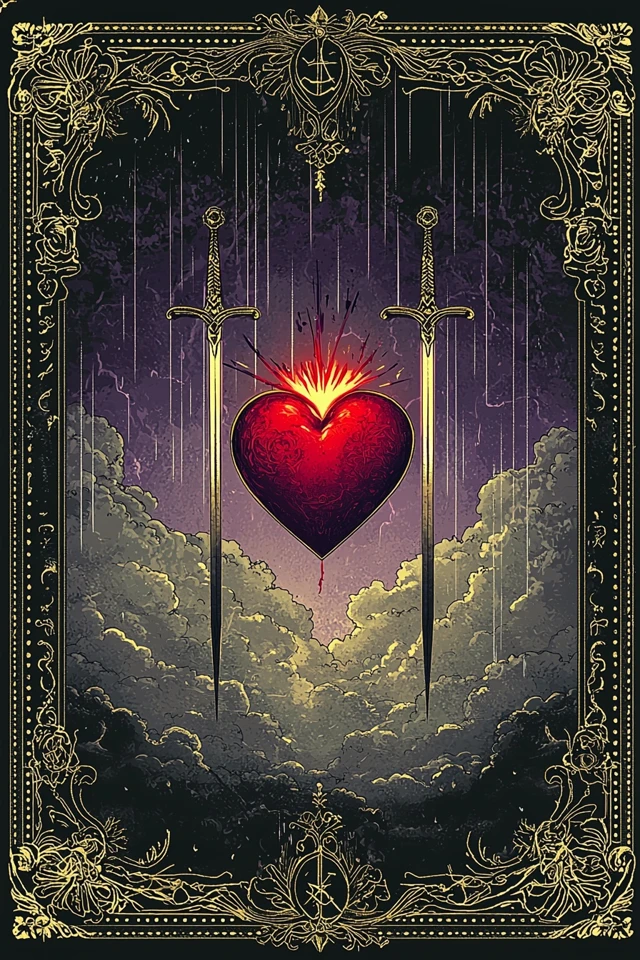
Three of Swords as Feelings
A feelings reading asks the cards to describe what someone is emotionally experiencing — what they consciously feel, what they have not yet admitted to themselves, and what is just beginning to stir. Three of Swords arrives in this position with a particular texture. Read the card as a description of the emotional weather around the connection, not as a verdict on the relationship.
❦ Three of Swords as Feelings — Upright
The Three of Swords as feelings is one of the cards that readers most often catastrophise, and it deserves a careful, honest read. At its core, this card describes pain — emotional hurt that the other person is currently carrying in relation to you or to the connection. The three swords through the heart do not mean they hate you, do not mean the relationship is dead, do not necessarily mean betrayal. They mean something has wounded them, and they are still inside that wound.
There are several common versions of this. They may have been hurt by something you said or did, even if you did not intend the impact you had. They may be carrying grief from a previous relationship that has not finished resolving, and that grief is colouring their ability to be present with you. They may be hurt by something neither of you caused — a family situation, a job loss, a personal disappointment — that has left them with less emotional capacity than usual, and the lack of capacity is showing up in your connection. In all versions, what they feel is genuine pain rather than the absence of feeling.
This matters because it changes how to respond. People who are inside the Three of Swords are not coldly disengaged from you — they are too sore to fully show up. Pressing for warmth from someone who is bleeding tends to make them retreat. What they usually need is gentleness, patience, and the simple acknowledgement that something hurts. If the hurt is about something you did, an honest apology delivered without defensiveness goes further than any quantity of explanation. If the hurt is about something else, your most useful move is to be the safe place rather than the demanding one. The card is heavy, but it is not hopeless. Wounds heal when they are tended.
↻ Three of Swords Reversed as Feelings
The Three of Swords reversed as feelings is one of the most quietly hopeful reversals in the entire deck. The acute pain that defined the upright card is releasing its grip on them. They are not yet free of it, but the grief is no longer the only weather in the sky. There are more hours, then more days, when the wound is not the loudest thing in their mind, and the connection with you is starting to become possible again in ways it has not been for some time.
If the hurt was caused by something between you, the reversal often points to forgiveness becoming available — not always announced, sometimes silent, but real. They are softening. The defensive armour that kept you at arm's length while they processed what happened is lowering, and they may begin to reach out in small ways: a text that does not refer to the wound directly, a willingness to be in the same room again, a question about your day that signals interest is returning. Receive these gestures gently. Do not demand they be larger than they are. Small returns of warmth, repeated, do more than dramatic reconciliations.
If the hurt was from elsewhere — a previous relationship, a personal loss — the reversal shows them slowly recovering enough capacity to be present in the new connection. They are not asking you to pretend nothing happened; they are asking, sometimes wordlessly, whether you can be patient while they finish healing. The answer to that question is yours to make. The card is honest: this stage can take months. There may be setbacks around anniversaries or unexpected reminders. But the underlying movement is toward integration. The wound is closing. They are coming back into reach.
💭 How They Feel About You
Right now, they are hurting — and the hurt is the dominant feeling they have in relation to you. This does not mean they have stopped caring. Often the pain is here precisely because they do care, and the caring has met something that wounded them. They may feel sad, betrayed, disappointed, or simply tired in a way they cannot easily explain. They may also feel guilty, especially if they think their pain is unreasonable or larger than the situation warranted. Whichever flavour the hurt takes, it is taking up most of the room.
If you have noticed them pulling back, going quiet, or seeming less affectionate than usual, this is what you have been picking up on. They are not coldly assessing the relationship; they are too sore to engage with it at full strength. The card asks you to read the withdrawal as protection rather than rejection. They are pulling in to tend the wound, not to leave. Your gentlest, most patient presence is far more useful right now than any attempt to fix what they are feeling. Acknowledge that something hurts without demanding to know every detail. Let them lead the pace of return. Wounds tended kindly close more reliably than wounds prodded for explanations.
Frequently Asked Questions
It means they are in real emotional pain in relation to you or to the connection. The card does not specify the cause — sometimes it is something you did, sometimes something they brought in from elsewhere, sometimes circumstances that hurt them both. The crucial point is that they are not coldly indifferent; they are hurting, and the hurt is so present that it is shaping how they show up. Pressing for warmth from someone in this state tends to push them further into protection. Acknowledging that something is sore, without demanding a full explanation, opens more doors than any other response.
Not always, and the reading is often unkinder than it needs to be. Heartbreak is one form of the Three of Swords, but the card also covers disappointment, grief carried in from somewhere else, the pain of unmet expectations, and ordinary hurt that has not yet been talked about. It is wise to read it as "real pain is present" rather than as "the relationship is over." Many connections survive this card by tending the wound honestly. The cards that surround it matter — look for what kind of pain is being shown and whether the surrounding context suggests healing or further harm.
If you genuinely caused hurt, yes — a clean apology delivered without defensiveness goes further than any other move. Do not pair it with explanations of why you did what you did, at least not in the same breath. Acknowledge the impact first; the context can come later if they ask. If you are not sure whether you caused the hurt, ask gently rather than guess. Sometimes the pain is about something else entirely and your trying to apologise for it can feel like you are making it about yourself. Curiosity is usually more useful than assumption here.
Often, yes — particularly if you read the reversed card in a follow-up reading or see surrounding cards that suggest healing. The Three of Swords describes the acute phase of pain; it is rarely the end of the story. Wounds heal when they are tended, and many relationships find their deepest connection on the far side of having survived something hard together. That said, the card is honest. Some hurt cannot be repaired, and rushing reconciliation before the wound has actually closed tends to reopen it. Patience is the medicine. Trust the slow return more than the dramatic one.