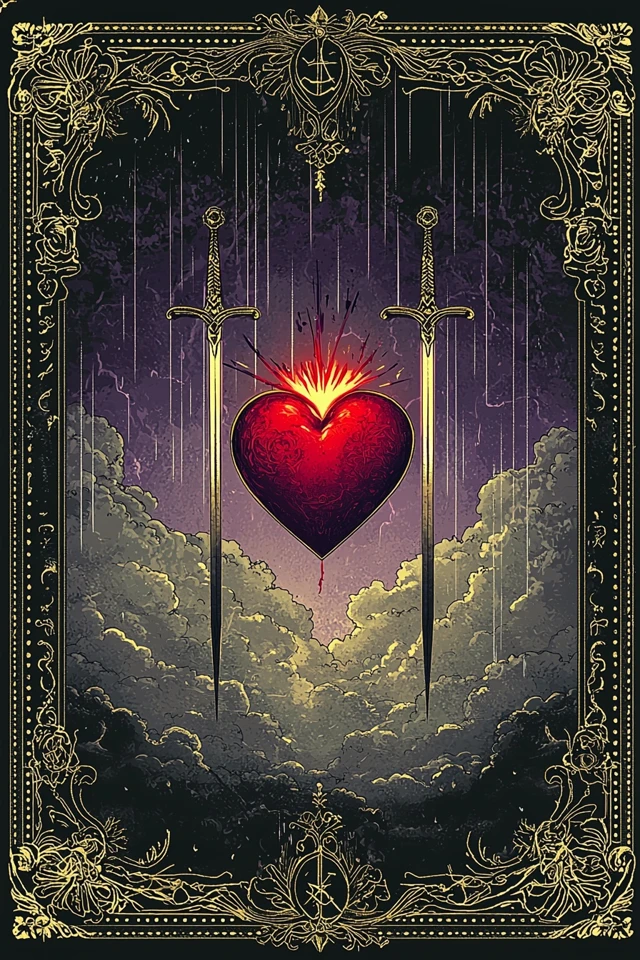
Three of Swords Reversed
A reversed card is not a flipped-meaning card. Three of Swords reversed asks you to look at the same energies as the upright version, but from a less comfortable angle — where the qualities are blocked, exaggerated, withheld, or expressed in shadow form. Most often, the reversal is more useful than the upright reading, because it points to something internal that you can actually change.
Three of Swords Reversed — Meaning
A period of healing and recovery. Grief is lifting and forgiveness is becoming possible.
Reversed, the Three of Swords signals a movement through grief rather than a deepening of it. The acute phase of pain is beginning to ease, the wound is slowly closing, and the first tentative steps toward healing are becoming possible. However, the reversal can also indicate that grief is being suppressed or prolonged unnecessarily — either by refusing to feel it at all (pushing through without processing) or by revisiting and rehearsing it long past the point of usefulness. It may point to someone clinging to the narrative of their hurt because releasing it feels like a betrayal of the experience, or because the pain has become part of their identity. The invitation of this reversal is to distinguish between honouring what you have been through and being held captive by it. Healing is not forgetting; it is integrating.
❤️ Three of Swords Reversed in Love
The Three of Swords reversed in love is one of the most quietly hopeful reversals in the deck. The heartbreak that defines the upright card is starting to release its grip. The grief is not gone — it does not vanish on command — but it is no longer the only weather in the sky. You are beginning to have whole hours, sometimes whole days, when the pain is not the loudest thing in the room.
This is the card of healing in progress. It may show forgiveness becoming possible toward someone who hurt you, or toward yourself for choices you made when you were hurting. It may show the slow return of appetite, of laughter, of curiosity about other people. None of this happens evenly. You will have setbacks — anniversaries, photographs, songs that ambush you in the supermarket — and they will feel like backsliding. They are not. Recovery from a broken heart is recursive rather than linear, and the reversed Three honours that.
If you are still inside the pain, the Three of Swords reversed in love is a gentle promise rather than an instruction. You do not need to rush the grief to be useful for it. The card simply notes that the worst of it has passed, even when you cannot yet feel that, and that the work now is to keep tending the wound rather than reopening it. Be slow with yourself. Let other people in carefully. Trust that what feels like dull ache today will, in time, become a story you tell with a softer voice.
💼 Three of Swords Reversed in Career
The Three of Swords reversed in career marks recovery from a professional wound — a redundancy, a public failure, a betrayal by a colleague you trusted, a project that collapsed loudly. The acute phase of the pain is behind you. You are no longer crying in the car park or rehearsing the conversation that broke you. The lesson is integrating, even if you cannot yet articulate what it was.
This reversal also shows the slow return of confidence after a hit. You may not yet be ready to leap back in at full strength, and you should not force yourself. The instinct to prove you are unbroken by overworking the next opportunity is a trap; it tends to recreate the very dynamic that hurt you. Choose your next move from a recovered place rather than from the urge to outrun what happened. Take the rest you actually need.
There is forgiveness work here too — sometimes of others, sometimes of yourself. You may be ready to stop replaying the meeting where it all went wrong, to release the colleague who undermined you, to forgive the version of you who did not see it coming. The Three of Swords reversed at work does not ask you to pretend none of it happened. It asks you to stop letting it be the only story you tell about your career. There is more after it, and you are beginning to feel that.
🌿 Three of Swords Reversed Spiritually
The Three of Swords reversed spiritually represents the soft passage from acute grief into integrated wisdom. The wound is closing — not vanishing, but becoming part of who you are rather than a fresh injury you keep examining. You may notice you can think about the loss now without the bottom dropping out of your chest, and that small return of stability is a holy thing.
This reversal often brings a renewed sense of meaning. The pain you went through, while you would not wish it again, is beginning to feel like it belongs to your story rather than being an interruption of it. You may find yourself more able to sit with other people in their pain, more able to tell the truth about hard things, more reluctant to perform fine when you are not fine. These are gifts. They cost a great deal, and they are real.
The Three of Swords reversed spiritually also warns gently against premature transcendence. There is a temptation, when grief begins to lift, to leap straight into the lesson — to declare what it taught you, to wrap it in a tidy spiritual frame so you never have to feel the raw edge again. Resist that for a while longer. Some wisdom only forms when you let the pain finish speaking. Stay with the slow, honest recovery. The meaning will arrive on its own, and it will be more trustworthy for not being rushed.
Frequently Asked Questions
It usually means heartbreak is beginning to heal. The acute grief of the upright Three is loosening its grip — you are having more hours when the pain is not the loudest thing. Forgiveness, of yourself or of the person who hurt you, is becoming quietly possible. This is not a linear process; expect setbacks around anniversaries or unexpected reminders. The card reversed honours those without taking back the progress. Be slow and patient with your own recovery. The wound is closing, even when on a hard day you cannot feel that it is.
No — it is one of the gentler reversals in the deck. The upright card is the moment heartbreak lands; reversed, you are past the worst of it and into recovery. The pain is no longer fresh. You can begin to think about what happened without being undone by it. Forgiveness, integration, and a careful return to openness all become possible. The card does not promise the grief is over, only that the acute phase has passed and healing is genuinely underway. That is a deeply hopeful place to receive a Three of Swords from.
It points to the conversation after the wound — the talk where you finally say what hurt, or hear what hurt the other person, without re-opening the injury. Communication at this stage tends to be quieter and more honest than during the conflict itself. There may be apologies that have taken months to form, or simple acknowledgements that something happened and mattered. You may also need to talk about the pain with a friend, therapist, or journal rather than with the person involved. Speaking grief out loud is part of how it leaves the body.
Take it as permission to recognise how far you have actually come, even if the pain is still present. Make space for grief without making it the whole story. Practical steps: notice the hours that are easier now, name them, let them count. Resist the urge to leap into the lesson before the feeling has finished. Be careful about who you let close while you are still tender. The card asks you to keep tending the wound rather than test it. Healing is happening on its own clock — your job is mostly not to interrupt it.