
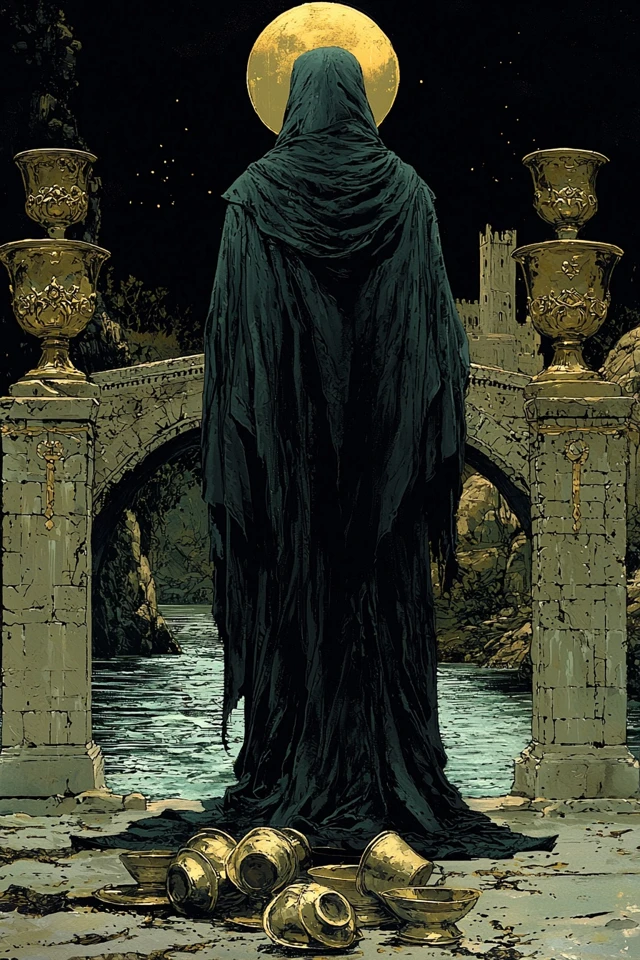
The grief that completes the parting — mourning a chapter that has, finally, actually ended.
The Reading
Death and Five of Cups describe a particular grief: the kind that arrives only once the loss is fully real. The Five of Cups alone is mourning — three cups spilled, two still standing, the figure hooded and looking at what is gone. Death adds the missing piece. The chapter is not paused. It is not in repair. It is over. The mourning in this pair is not premature and not stuck; it is the grief that fits exactly to its event.
What separates this combination from Five of Cups alone is the absence of false hope. Plain Five of Cups often appears for losses where some part of the querent is still bargaining — could it come back, was it really my fault, what if I had said the other thing. Death cuts that line. The relationship ended, the parent died, the version of the career closed, the body changed permanently. The work the pair describes is not deciding whether to grieve. It is grieving cleanly, without the noise of imagined alternatives.
In practice the pair tends to arrive months after the actual ending — sometimes six, sometimes a year. The early phase of loss is usually busy with logistics, denial, anger, attempts at reversal. Death + Five of Cups lands when the busy phase has burned off and the quieter, longer mourning begins. Clients pulling this pair often describe feeling worse than they expected to at this point, and being puzzled by it. The pair's reassurance is that the timing is correct. Grief catches up to its event on its own schedule, and the schedule is rarely the one anyone predicts.
The shadow is permanent residence in the spilled cups. Some querents make the loss into an identity — referring to themselves first by what was taken, organising their year around the anniversary, refusing to notice the two cups still standing because acknowledging them feels like betraying the three that are gone. The pair becomes a posture rather than a passage. Death is supposed to complete; if the grief is being maintained as a memorial rather than processed as a feeling, the completion never happens. The trap is mistaking continued sorrow for continued love.
This pair misleads when the querent has not yet accepted the loss is real. Pulled too early — in the first weeks of a fresh ending — Death + Five of Cups can read as catastrophising when the actual emotional task is still triage. Conversely, pulled years after an event the querent has technically moved on from, the pair often surfaces a grief that was buried and is now asking to be felt. Ask when the loss happened. If it is recent, the pair is forecast. If it is old, the pair is invitation.
If The Star or Six of Cups appears alongside, healing is genuinely underway and the pair is closing rather than deepening. If The Moon or Seven of Cups sits nearby, the querent is mourning a version of the loss that is partly imagined — the work needed is distinguishing what actually happened from what they wish had been possible. If Judgement appears, the grief is preparing the querent for a return to the world in a different form.
Working readers do not tell people to look at the two standing cups too quickly. That move, made before its time, is exactly what keeps clients stuck — they sense the move is premature and refuse it, often by clinging harder to the loss. The right pace is to sit in the spilled cups with them, name the three losses precisely, and only later — sometimes much later — ask what they are still holding that they have not noticed. The question worth asking is "what version of yourself did you lose here?" The answer is often the actual subject of the grief.
In love this pair is the partner who is genuinely gone — through death, through final estrangement, through a parting that both parties have agreed is permanent. The grief is real and proportional. New love, when it eventually arrives, will not feel like replacement; it will feel like a different country.
Career-wise the pair arrives around the role that closed for good — the company that folded, the field that no longer exists in the form you trained for, the mentor who died, the version of the work that you can no longer physically do. The grief is for the path not taken from here, and it deserves to be felt rather than briskly redirected.
Spiritually this is the loss of a faith, a community, or a self-image whose ending is genuinely final. There will not be a return. The work is the slow accommodation to living without something that was foundational, and the eventual discovery that a different foundation is possible — though not yet today.

Frequently Asked Questions
Because real grief does not follow the diagram of stages most people are taught. It often deepens around the six-to-twelve-month mark, when the support of others has thinned and the daily reality of absence has become permanent. The pair confirms the timing is normal, not a sign of regression. Many clients describe month eight or nine as harder than month two, precisely because the loss has finally fully registered. The pair is not asking you to push through; it is telling you the schedule is correct and the worst of the second wave is finite.
Yes — and the framing of "moving on" is part of why grief gets harder. The pair is not interested in moving on. It is interested in moving through. The two are different. Moving on implies leaving the loss behind; moving through means carrying it forward in a way that does not foreclose the rest of your life. Most clients who think they need to move on are actually being asked, by themselves and others, to perform okayness for someone else's comfort. The pair gives you permission to drop the performance.
Not in the same form, and the pair is honest about that. What you had was specific to that person, that role, that version of your life. What is possible is loving differently — with a different person who occupies a different shape in your life, with a different vocation that uses different parts of you. New love does not erase old love or replace it; it sits alongside. Most clients who eventually find new love describe it as smaller in places and larger in others, never identical.
Acute grief — the part that makes ordinary functioning hard — usually softens between months eighteen and twenty-four. The longer accommodation, where the loss becomes a fact of your biography rather than a current crisis, runs three to five years. Grief never fully disappears for major losses, and the pair is clear that the goal is not disappearance. The goal is integration. Most clients report that by year five, the loss is part of who they are rather than what is happening to them.
Possibly, but the pair is uninterested in that line of thought. Death + Five of Cups describes losses that are final, and final losses do not respond to retrospective edits. The "what if" loop is one of the most common ways grief stalls, because it offers the false promise that the loss could be undone with enough analysis. The pair, gently, refuses that promise. The honest answer to "what could I have done differently?" is usually "perhaps something, perhaps nothing, and either way it is no longer available." That sentence, fully accepted, is part of the healing.
Use the Tarot Combination Calculator to discover what any two cards mean together.
✦ Open Calculator