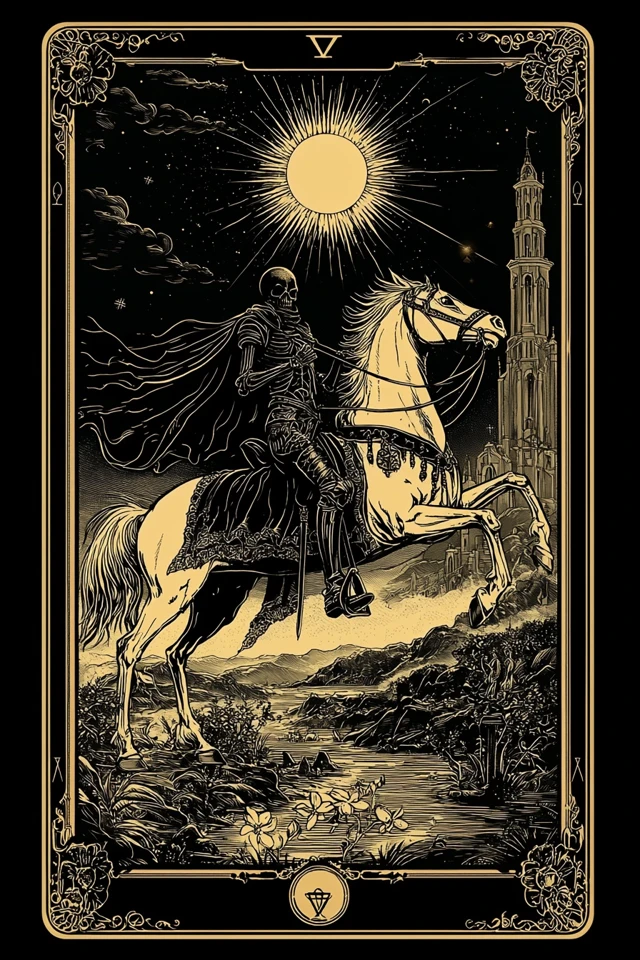
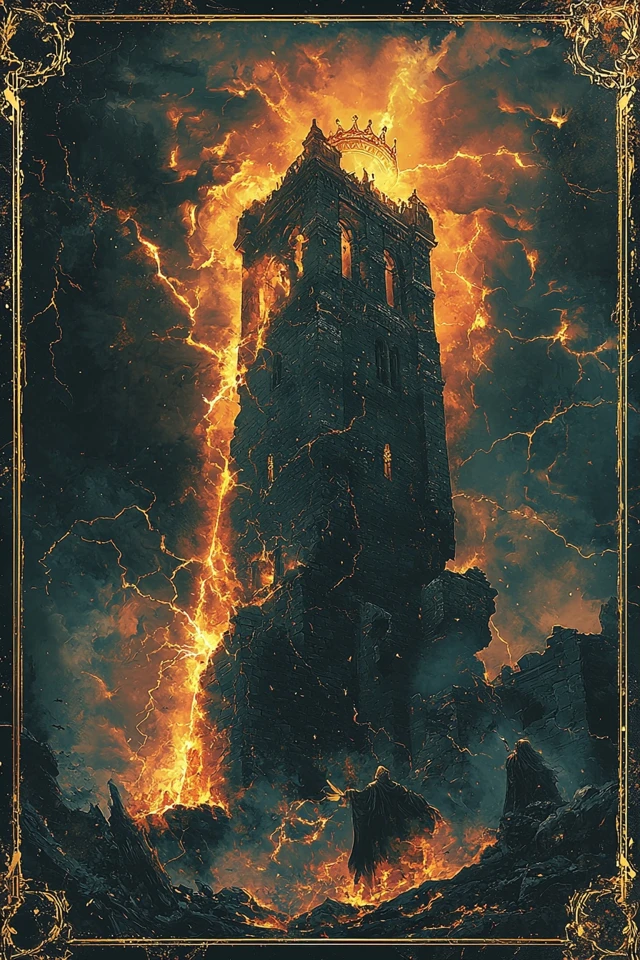
Two endings stacked on top of each other — one chosen by life, one chosen by you.
The Reading
Death and The Tower together describe a moment when the structure was already failing and the universe ran out of patience waiting for you to walk away from it. Tower is the wall coming down; Death is the recognition that you cannot live in that house anymore even if it were rebuilt. The pairing rarely shows up for tidy losses. It tends to arrive around the marriage that ended six months before either person admitted it, the job that became unsurvivable the week before the redundancy notice, the identity that cracked under a single late-night realisation.
What makes this combination different from Tower alone is the after. Tower destabilises; Death insists you do not return to the previous form. A reader seeing both cards close together should resist the urge to comfort the querent with "you'll rebuild." Often the message is the opposite — that the rebuilding instinct is what the cards are warning against. You are not meant to reconstruct the thing that was just dismantled. You are meant to let it stay gone.
Practically, the two cards combined tend to compress timelines. What might have unfolded over years happens in weeks. People going through this pairing describe a sense of cinematic clarity — knowing exactly what to keep and what to discard, sometimes with a coldness that surprises them later. That coldness is the combination doing its job. Sentimentality protects what should be released.
The shadow side is collapse without release. The Tower keeps cracking — relationships, money, body, faith — and Death never completes its work, because the querent keeps trying to restart the previous life in a smaller form. This shows up as moving cities to escape a relationship you then recreate, leaving a job to take an identical worse one, switching partners without changing the pattern that exhausted the last one. The cards are signalling that surface change is no longer enough; the combination demands a structural rewrite.
Death and Tower together are sometimes misread as catastrophic prediction when the querent is actually mid-recovery. If the question is asked about a crisis that has already happened — a breakup three months ago, a layoff last winter — the combination often means the rupture worked. The collapse cleared the ground that the next thing requires. Read the timing of the question, not just the cards. The same pair means very different things on day one of a crisis and on day ninety.
If The Star, The World, or Temperance also appears in the spread, the destruction has a redemptive arc — read the combination as labour pain, not death. If The Devil or 10 of Swords appears alongside, the destruction is unfinished — there is one more attachment to release before the new ground can be walked on.
Experienced readers tend not to soften this pair. They name the ending honestly, then ask the harder question: what was the querent loyal to that prevented them from leaving earlier? That loyalty — to a vow, an image, a parent's expectation, a sunk cost — is usually the real subject of the reading. The cards are not the news; the loyalty is the news, and the cards are simply forcing the conversation.
In love this combination signals a relationship that cannot return to a previous version of itself. If the relationship continues, it must be on entirely new terms — old roles, old promises and old grievances all written off. If it does not continue, the parting tends to feel less like loss and more like recognition.
Career-wise the pair often arrives around a forced exit that turns out to have been overdue — a redundancy, a project collapse, a falling-out with a mentor. Resist the instinct to chase the same role at a different company. The combination wants you to question the shape of the work, not the wallpaper of the office.
Spiritually this is the dark night that ends a phase rather than visits one. A belief, a teacher, a practice, or a self-image you treated as load-bearing turns out not to have been. The work is to let it go without replacing it immediately. The space is the lesson.
Frequently Asked Questions
Not always, but it rules out the relationship continuing in its current form. If you read this pair during a relationship question, the conversation worth having with your partner is whether you are both willing to rewrite the contract from scratch. If either of you wants to preserve the previous version, the pair is telling you the previous version is already gone.
Yes — particularly when the querent has been stuck in a known bad situation and the cards confirm that release is imminent or has already begun. The pair tends to feel positive in retrospect even when it feels brutal in real time. The thing being lost was usually costing more to keep than to release.
Avoid replacement decisions — choosing the next job, the next partner, the next city in the first weeks. The pair compresses timelines and creates false clarity that often does not survive contact with reality. Decisions about what to release are usually trustworthy; decisions about what to grab are usually premature.
Death and Judgement describes a chosen ending followed by a calling forward — there is agency and direction. Death and The Tower describes an ending where life forced the timing, and the call forward has not arrived yet. With Death + Judgement you are stepping into something; with Death + Tower you are simply no longer where you were.
The acute phase — the part that feels like free fall — usually lasts three to six months. The slower work of not reconstructing what was lost typically takes a year. Readers checking back in at six months often find the querent in a far different shape than they expected, frequently better than the querent themselves predicted.
Use the Tarot Combination Calculator to discover what any two cards mean together.
✦ Open Calculator