
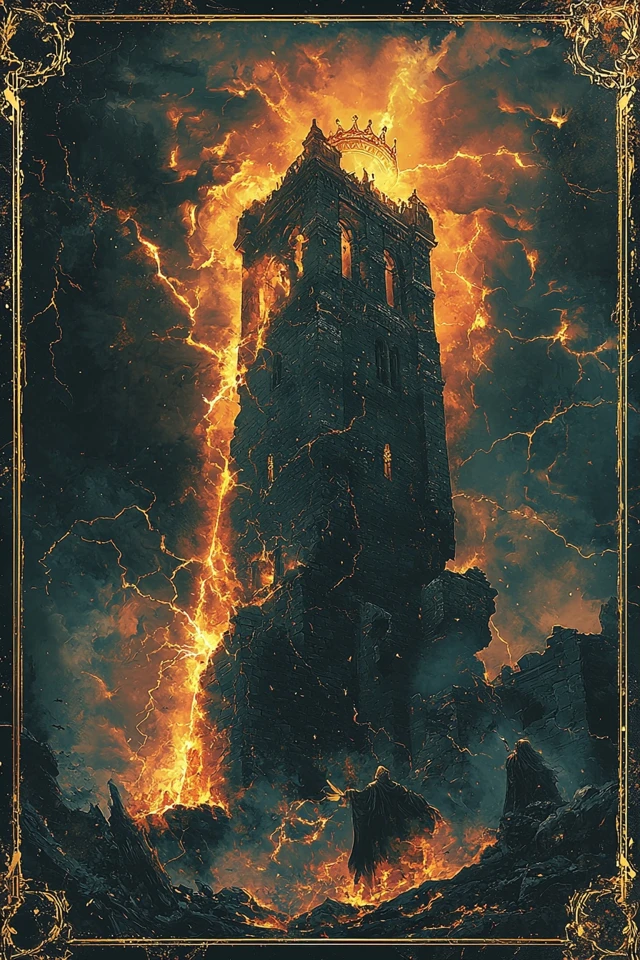
The chain snaps because the wall fell — freedom you would not have chosen, taken anyway.
The Reading
The Devil and The Tower describe the moment a bond you could not break on your own is broken for you. The Devil is the structure you had agreed to live inside — the relationship that ran on control, the addiction that organised your week, the job whose paycheque had become a leash, the family role nobody let you put down. The Tower is the shock that ends the arrangement without your consent. A discovery, an arrest, an overdose scare, a partner walking out, a body that refuses to keep performing — something external removes the choice you had been refusing to make.
What separates this pair from Tower alone is the relief underneath the wreckage. People going through Devil + Tower often describe a strange lightness within days of the collapse, even when the surface story is catastrophic. That lightness is diagnostic. It is the system noticing that the cost of the bond is no longer being paid. The pair almost never shows up for losses that were genuinely free choices; it shows up for losses that look like disasters from the outside and feel like exhalations from the inside.
In practice the pair tends to compress an exit you had been negotiating with yourself for years into about ten days. Money, housing, custody and reputation all shift faster than you would have planned. The hardest part is usually not the leaving — it is the realisation, six weeks in, that you genuinely cannot reconstruct the previous arrangement even if you wanted to. The Tower made the cage uninhabitable, not just unlocked.
The shadow is escaping one Devil only to walk into a near-identical one within months. The pair clears a bond but does not, by itself, change the appetite that built the bond. People who skip the integration work tend to recreate the dynamic with a new face — same intensity, same control patterns, same exhaustion — and read the next Tower as bad luck rather than a repeat performance. The trap is treating the shock as the lesson. The shock is the doorway; the lesson is whatever you were getting out of the cage that you have not yet replaced.
This pair misleads when the querent reads it as warning instead of report. By the time Devil + Tower lands in a spread, the rupture is usually already happening or has just happened — the cards are describing the present, not predicting the future. Readers who treat it as forecast tell clients to brace for impact and miss that the client is already on the floor. Ask when the situation actually began. The combination almost always points to something that broke at least a few weeks before the reading, sometimes longer.
If The Star or Temperance appears nearby, the freedom holds and the next bond is healthier — read the pair as genuine liberation. If The Moon or 7 of Cups appears, the querent risks fantasising about the lost arrangement and walking back in; treat the reading as a warning against romanticising the cage. If 4 of Pentacles or 9 of Swords sits alongside, the bond is psychological rather than physical and the work is internal.
Working readers do not celebrate this pair, even when it is obviously the right outcome. Clients in the middle of Devil + Tower are usually grieving the cage as well as the freedom, and being told "this is great news" lands badly. The question worth asking is what the bond was protecting them from — being alone, being seen, being responsible, being ordinary. That answer is the actual reading. The cards have already done the dramatic work; your job is to help the querent name what they were buying with the bondage so they do not buy it again from someone new.
In love this pair is the affair that gets exposed, the controlling partner who finally crosses a visible line, or the dependency dynamic that collapses under a single confrontation. The relationship rarely survives in its existing form. What can survive — sometimes — is the two people, after a long separation and significant individual work.
Career-wise the pair often arrives around a job that had become quietly soul-eroding and ends through scandal, restructuring, or a sudden inability to keep going through the door. The exit feels involuntary but is usually overdue by a year or more. Resist taking the first replacement role; the appetite that kept you in the wrong job needs examining first.
Spiritually this is the breaking of a vow you should not have made — to a teacher, a community, a self-image, a story about who you owe. The break is rarely graceful. The work afterwards is learning to live without the identity the vow was holding in place, which is harder than the parting itself.

Frequently Asked Questions
Often, yes — but exposure is rarely the full story. The pair shows up around moments when a hidden compulsion becomes visible to people who matter, whether through a health scare, a financial collapse, a partner finding evidence, or an event you cannot edit out of the record. The exposure is not the punishment. It is the structural change that makes continuing the behaviour materially harder. The recovery work begins after, not because of, the exposure.
No — that response is exactly what this combination tends to produce. When a controlling, addictive or abusive bond collapses through external shock, the body often registers safety before the mind catches up to the loss. The relief is real and trustworthy. Grief usually arrives later, in pieces, and is more about lost time and the version of yourself you were inside the bond than about the partner. Both feelings are valid; the relief is not denial.
Frequently, yes, and the pair signals that the attempts will be intense rather than subtle. Expect grand gestures, sudden vulnerability, threats, third-party messengers, or an apparent transformation. The combination is named by the rupture, not the reconciliation — if the bond reforms, the next Tower lands harder. Block channels, document contact, and assume the first six months are the window where you are most likely to walk back in. Protect that window.
Not in its previous form, and the pair is unusually firm on that point. What sometimes works is a completely renegotiated version — different living arrangement, no shared finances, individual therapy first, no contact for a defined period — built only after the freedom has been lived in for at least a year. Anything attempted in the first six months tends to be the cage repainted. If the other party will not accept those terms, the cards are answering for you.
Devil + Death describes a bond you actively choose to end, usually after a long internal process — there is grief but also agency. Devil + Tower describes a bond that ends through external shock before you were ready to end it yourself. The aftermath is similar; the texture is different. Tower clients carry more disorientation and less guilt; Death clients carry more guilt and less surprise. Both arrive in the same place eventually.
Use the Tarot Combination Calculator to discover what any two cards mean together.
✦ Open Calculator