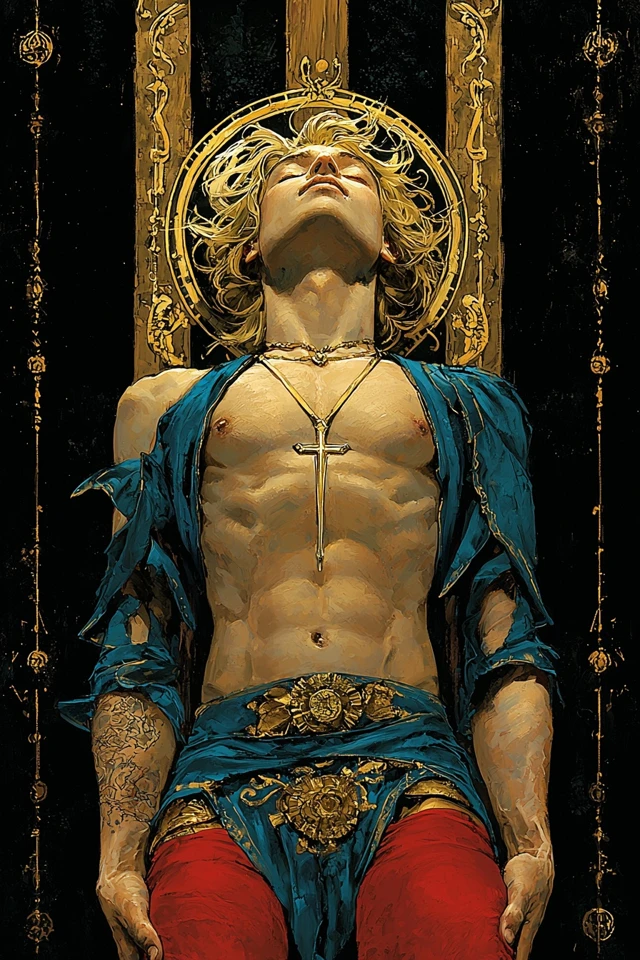
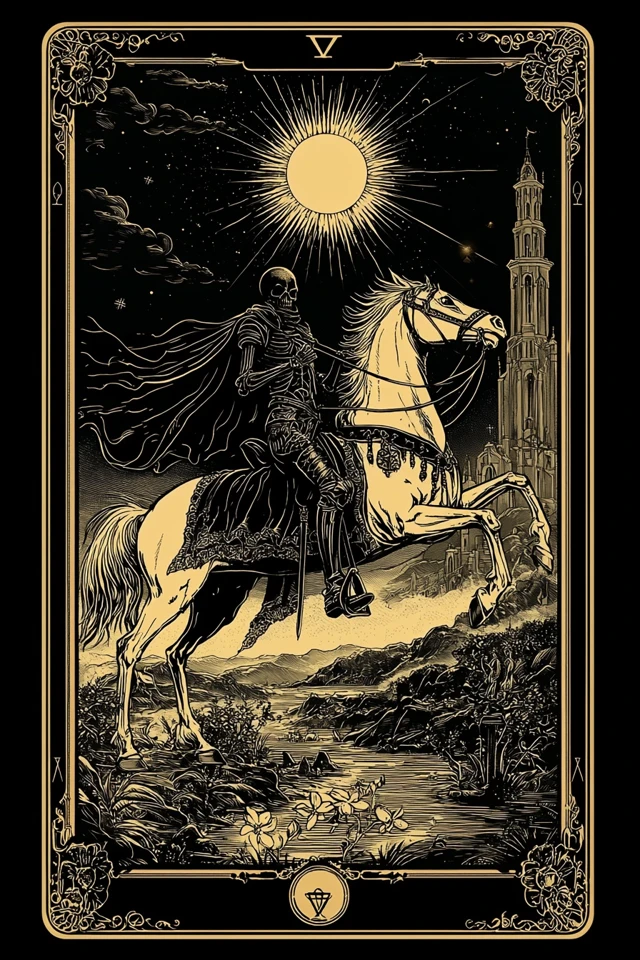
The pause you chose has become the ending you needed — surrender doing what force could not.
The Reading
The Hanged Man and Death describe a transformation entered through stillness rather than shock. The Hanged Man is the deliberate pause — the sabbatical, the meditation retreat, the relationship taken off the table for six months, the year of therapy, the deliberate withdrawal from a path that was working on paper. Death is what the pause turns out to have made permanent. You stopped to think, and during the thinking the previous arrangement quietly stopped being viable.
What sets this pair apart from Death and The Tower is the absence of violence. There is no scene, no precipitating event, no rupture to point at later. The querent simply notices, somewhere during the suspended period, that they will not be returning to the previous form of their life. The job they were on leave from is not the job they will go back to. The marriage they were taking time apart from has already, in some private chamber, ended. The identity they were resting from is gone. The pause was not the holiday from the life; it was the life ending in slow motion.
In practice the pair tends to produce decisions that look sudden to outsiders and feel inevitable to the querent. Friends and family ask "when did this happen?" and the honest answer is "during the long quiet you did not see." Readers who encounter this pair often find the client unusually calm, almost detached, when describing what is changing. That calm is not denial. It is the result of a transformation that had time to integrate before it had to be announced.
The shadow is the pause that never ends. Some querents enter Hanged Man surrender as a strategy and stay there for years — perpetually about to make the decision, perpetually in suspension, using the meditative pose as a way of avoiding the actual ending. Death never arrives because nothing is allowed to die. The marriage limps on in name only; the career is technically still active but actually abandoned; the identity is neither inhabited nor released. The trap is treating reflection as a substitute for action. The Hanged Man's gift expires; sit in the position long enough and it becomes ordinary paralysis.
This pair misleads when read for someone in acute crisis. Hanged Man + Death describes a transformation chosen and absorbed at a slow pace; if the querent is currently in free fall, the pair is either premature or describes the post-crisis integration phase rather than the crisis itself. Ask whether the period of pause has actually happened. If the answer is "I am about to take time off" or "I am thinking about taking a break," the pair is forecast. If the answer is "I have been on leave for three months," the pair is report. Treat the two readings differently.
If The World or Judgement appears alongside, the transformation completes cleanly and the new chapter is already visible. If The Devil or Eight of Swords sits nearby, the pause is being used to avoid a decision rather than to make one — the work needed is naming the avoidance. If 8 of Cups appears, the walking-away is already underway and the pair confirms it is the right move.
A working reader handles this pair with patience the querent will not always reward. The right question is rarely "what are you going to do?" — it is "what stopped being true while you were resting?" That question gives the client permission to name the quiet ending they have already lived through. Many clients arrive with the news pre-formed but unspoken, even to themselves. The reading is the room in which they finally say it. Resist offering action plans in this pair; the action will follow naturally once the ending has been named aloud.
In love this pair is the relationship that ended during a deliberate separation, even though no one announced it. The time apart was supposed to be repair; it turned out to be a soft landing for a parting that had already happened internally. The kindest version closes without a fight; the cruellest version drags out because no one wants to be the one to say it.
Career-wise the pair arrives around the sabbatical, the burnout leave, or the long sick period that quietly becomes a resignation. The work itself did not end; the version of you that did it ended. Returning to the same role after this pair almost never lasts more than a few months.
Spiritually this is the practice that genuinely worked — a retreat, a period of study, a long depression even — and rearranged your interior so thoroughly that the previous life cannot be reinhabited. The transformation is real, irreversible, and largely invisible to people who knew you before.
Frequently Asked Questions
Not necessarily end it, but it may end the current shape of it. The pair signals that genuine pause tends to surface truths the working pace was suppressing. If your current role is fundamentally a good fit, you will return to it changed but in place. If it is not, the time off will make that clear, and returning will feel impossible in ways you cannot fully argue against. Most clients who pull this pair before a sabbatical do not go back to the same job. They go back to themselves and find a different job from there.
Yes, but usually only if both partners are willing to acknowledge that the previous version has ended and a different relationship — with new terms, new boundaries, new structure — is being built in its place. If either partner is treating the pause as a wait for things to go back to normal, the pair almost always describes a quiet ending. The relationships that survive Hanged Man + Death tend to be ones where the parting and the rebuilding happened almost simultaneously, with both parties consenting to the new shape.
Because most of the grief work has already happened during the suspended period. By the time the visible ending arrives, the querent has often spent months metabolising the change in private. What looks to outsiders like cold detachment is usually the calm of a transformation that had room to complete. The grief that does arrive in this pair tends to be quieter and more about lost time than about the specific ending. Some clients feel guilty about not being more devastated; the lack of devastation is the gift of having paused properly.
Hanged Man pauses change you internally; procrastination keeps you the same and adds anxiety. After three months in a true Hanged Man period, you will think differently about the question that prompted the pause — you will see angles you could not see before, and the original urgency will have softened. After three months of procrastination, the question feels exactly as pressing and exactly as unsolvable as it did at the start. If you are more tired and no clearer, the pause is not doing the work.
It is both, and reducing it to one register usually misses the point. The transformation often begins in interior or spiritual territory — meditation, therapy, prolonged solitude — and then surfaces as completely practical decisions about work, partnership, and place. Clients who read it as purely spiritual sometimes resist taking the practical steps the inner change is asking for. Clients who read it as purely practical miss why the practical changes feel non-negotiable. Hold both layers.
Use the Tarot Combination Calculator to discover what any two cards mean together.
✦ Open Calculator