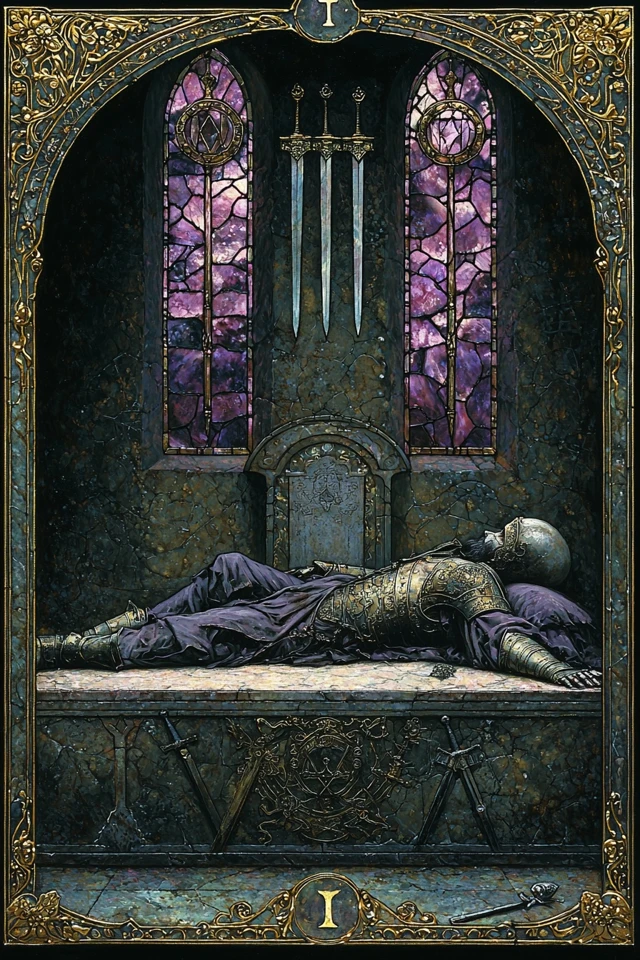
Four of Swords Reversed
A reversed card is not a flipped-meaning card. Four of Swords reversed asks you to look at the same energies as the upright version, but from a less comfortable angle — where the qualities are blocked, exaggerated, withheld, or expressed in shadow form. Most often, the reversal is more useful than the upright reading, because it points to something internal that you can actually change.
Four of Swords Reversed — Meaning
Restlessness, inability to truly rest, or beginning to slowly re-emerge after a period of recuperation.
Reversed, the Four of Swords suggests that either rest has gone on too long and stagnation has set in, or that necessary rest keeps being refused. In the first case, a period of recovery has become avoidance: the withdrawal that was once restorative has hardened into isolation or inertia, and the time to re-engage is overdue. In the second case, someone is pushing through exhaustion, anxiety, or burnout when what they most need is to stop. The body and mind have a wisdom that ignores signals at its peril, and this reversal often appears when that wisdom is being overridden by obligation, fear, or the inability to give oneself permission to rest. It can also indicate a restless, anxious quality to sleep or inner life — the mind unable to settle even when the body is still. The invitation is always the same: discern whether you need to return to action or finally grant yourself stillness.
❤️ Four of Swords Reversed in Love
The Four of Swords reversed in love often shows someone re-emerging from a period of relational hibernation. Maybe you took time away after a difficult breakup, deliberately stayed single to do inner work, or simply withdrew from the dating world to rest. The rest has done its job — and yet now you are caught in the threshold, unsure whether to fully re-enter or stay in the quiet a little longer.
There is another reading too: rest that has gone on too long. The retreat began as healing and slid into avoidance. You have used solitude as armour, and now any time someone shows interest the instinct is to disappear back into the cave. The card reversed asks gently whether the rest is still serving you, or whether it has become the new way of avoiding the very thing rest was meant to prepare you for.
If you are in an existing relationship, the Four of Swords reversed can indicate that one of you has been disengaged for too long. The phone scrolling on the sofa, the parallel lives, the quiet drift — these are forms of rest that have curdled. The card invites a careful return to presence. You do not need to fix everything in one conversation; you only need to begin showing up again, gently, and let the connection rebuild. Coming back is its own small act of courage. The card reversed honours both the rest you took and the work of stepping out of it.
💼 Four of Swords Reversed in Career
The Four of Swords reversed at work points to either restlessness after enforced stillness or burnout from refusing to stop. Both readings are common. In the first, you have been on extended leave, between roles, or in a quieter phase of your career, and you are beginning to itch for movement again. The card supports a slow return rather than a leap. Do not undo the recovery by sprinting on the first day back.
In the second reading, you have been running on empty and treating rest as something other people get to have. Your body has started filing complaints — headaches, insomnia, a heaviness that does not lift on weekends — and the card is reversed because you have ignored the upright instruction to stop. This is the gentler warning before something more forceful insists. Take the time off before the situation takes it for you. Cancel the optional commitments. Sleep is not weakness.
If you are leading a team, the Four of Swords reversed can show that your people are exhausted in ways you may not have fully seen. The output is still happening, but the spark is gone, and small mistakes are creeping in. Build in real recovery time, not performative wellness days. Burnout is much cheaper to prevent than to fix. The card reversed at work is fundamentally a course-correction toward sustainability — either step back into the world after rest, or step back from the world before collapse forces it. Choose now while choosing is still cheap.
🌿 Four of Swords Reversed Spiritually
The Four of Swords reversed spiritually shows the practitioner who has either rested deeply and is now ready to re-engage, or who has used spiritual retreat as a form of avoidance and is being gently called back. Both versions are honest possibilities. Ask yourself which you are in.
If you have done the rest, this reversal is a kind nudge that the world is ready for the version of you that emerged from it. The insights gained in silence are meant to be lived, not just collected. Returning to the world after deep practice can feel jarring — the noise is loud, people seem fast, your nervous system is recalibrating. Go gently. You do not have to grab everything that returns. Let yourself re-enter with the same care you used to withdraw.
If you have over-rested, the card reversed is honest with you. Meditation can become a hiding place. Spiritual practice can become a way to never have to engage with messy human relationships, difficult conversations, or the simple challenge of being a person in the world. The cave is meant to be temporary. The reversed Four asks: what are you avoiding by staying in retreat? The answer usually arrives quickly when you ask honestly. Re-entry, however clumsy, is the medicine. Practice is not the goal; it is preparation for a life lived more awake. Step back into that life now.
Frequently Asked Questions
It can mean re-emerging from a chosen period of being single or withdrawn — the rest has served its purpose and you are ready to be open again. It can also mean rest that has slid into avoidance, where solitude has stopped healing and started insulating. In existing relationships, the reversal often shows a slow drift back into presence after a quiet phase, or warns that one of you has been emotionally absent too long. Look honestly at whether the rest is still nourishing or whether it has become a way of not engaging with what love asks of you.
Not usually. It tends to mark a transition rather than a wound. If you have been in retreat, it signals that re-entry is near. If you have been refusing to rest, it is a gentler warning to stop before something more drastic insists. Either way the card is helpful information. The upright Four can be a forced stillness; reversed, you are recovering your agency around rest — choosing when to be still and when to re-engage rather than having either imposed on you. That return of choice is genuinely good news.
It often shows someone breaking a long silence — reaching out after months of being out of contact, replying to messages they had let sit, or restarting a conversation that paused. The communication may feel rusty at first. Words come slowly, tone is uncertain. That is normal and not a sign of failure. The card reversed honours that re-engagement is a skill that returns with practice. It can also mean noticing that someone has been quietly disengaged in a relationship and gently inviting them back into dialogue. Begin small.
Ask which version applies to you right now — emerging from rest, or stuck in too much of it. If emerging, go slow. Re-enter one area at a time rather than reclaiming everything at once. If over-resting, identify a specific thing you have been avoiding and take one small concrete step toward it this week. Either way, treat the transition with the same care you would treat physical recovery from illness. Sustainability matters more than speed. The card rewards a thoughtful re-engagement, not a triumphant return.