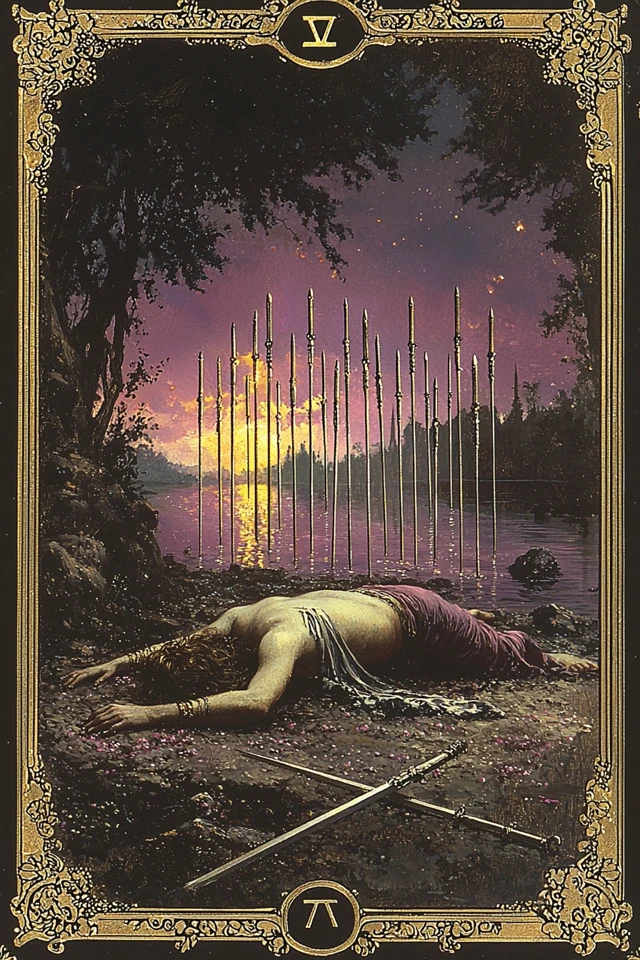
Ten of Swords as Feelings
A feelings reading asks the cards to describe what someone is emotionally experiencing — what they consciously feel, what they have not yet admitted to themselves, and what is just beginning to stir. Ten of Swords arrives in this position with a particular texture. Read the card as a description of the emotional weather around the connection, not as a verdict on the relationship.
❦ Ten of Swords as Feelings — Upright
The Ten of Swords as feelings carries one of the most intimidating images in the deck, and it is among the cards that get catastrophised the most often. An honest reading is more nuanced than the picture suggests. At its core, the card describes an ending — something between you, or something they were carrying, has reached the point where it cannot continue in its current form. The figure on the ground is finished with whatever phase this was, and a new phase will eventually begin. The dawn in the corner of the card is significant. Rock bottom is not, in itself, the end of the story.
What ends, exactly, varies. Sometimes the card describes the end of a particular dynamic between you — the fighting phase, the holding-back phase, the keeping-things-on-the-surface phase. The collapse of an old way of being is painful but not the same as the collapse of the connection itself. Many relationships find their deepest honesty on the far side of a Ten of Swords. Other times the card does describe a more total ending — they have reached a point where they cannot keep doing this with you, and the page is genuinely turning. Look at the surrounding cards for clarification on which version applies. The Ten of Swords on its own confirms an ending; it does not specify which one.
What this means for how to be with them is honest acceptance. Whatever has been finishing has been finishing for a while, and you have probably sensed it. Pretending otherwise tends to extend the pain rather than soften it. If repair is possible, it usually starts with both of you naming clearly what has died. If repair is not possible, the kindest action is letting the ending be what it is rather than dragging out the conclusion. The card is heavy, and the heaviness deserves respect. But the dawn is there. People come through this card, and what is built afterwards — whether with this person or apart from them — is usually more honest than what came before. The collapse is the precondition for the next thing. Trust the dawn even while sitting with the dark.
↻ Ten of Swords Reversed as Feelings
The Ten of Swords reversed as feelings is one of the most genuinely hopeful reversals in the deck when read accurately. The worst is behind them. The collapse that defined the upright card has happened, and recovery is underway. The figure on the ground is beginning to rise. They are not yet fully restored — recovery from the Ten of Swords takes longer than people often want it to — but the direction has reversed. Each day is now a little less heavy than the one before.
For many querents, this is welcome news. If you have been waiting through their dark phase, the reversal suggests the waiting is paying off. They are coming back into reach, in small ways at first, then in larger ones. Receive their early gestures gently. Do not require them to immediately be the version of themselves they were before whatever collapsed; that version is gone, and what is rebuilding will be different. The rebuild is often deeper and steadier than what came before, but it takes time, and the early days of recovery are tender.
The harder reading is that the recovery is being resisted. They have survived the collapse but are clinging to the ruins rather than letting them be ruins. The reversal in this version describes someone who is refusing to acknowledge that the old phase is over, and the refusal is keeping them stuck inside an ending that needed to be completed in order for them to move on. If you suspect this version, the most useful thing is your own honest acceptance of what has happened. They cannot recover from an ending they will not admit is real. Sometimes seeing someone else accept the truth is what eventually allows them to accept it themselves. The dawn is available; not everyone walks toward it on the timeline you would hope for.
💭 How They Feel About You
Right now, they feel emptied out. Something has reached the end of what it could be in its current form, and the recognition of that ending is what they are mostly processing. Underneath the emptiness there are real feelings — grief, sometimes relief that whatever was unsustainable has finally collapsed, sometimes a flickering hope about what might be possible afterwards. But the dominant note is exhaustion. They do not have a lot of capacity for anything that requires reaching.
If you have felt them as absent, distant, or strangely calm in a way that worries you, this is what is happening underneath. They are at the still point that follows an internal collapse. The Ten of Swords does not produce the kind of feelings that are easy to perform or articulate. They may not be able to tell you what they feel because what they feel is closer to nothing than to something, and the nothing is itself a recovery process. Your most useful posture is patience that does not require them to produce more than they have. Be present. Do not demand explanations they cannot yet give. Trust that the dawn at the edge of the card is also at the edge of their experience, even when they cannot yet feel it. People do come back from this card. It just takes longer than most readers want to admit.
Frequently Asked Questions
It means something has ended or is ending — either a particular phase between you, or in harder readings, the connection itself. The card describes a collapse that has reached the point where it cannot continue in its current form. The dawn at the edge of the image is significant; rock bottom is not the end of the story, and many people come through this card into something steadier than what they had before. Look at the surrounding cards to see which ending is being described. On its own, the Ten of Swords confirms that an ending is here, without specifying which.
No, despite how dramatic the imagery is. The Ten of Swords can describe the end of a difficult phase, a pattern, or a dynamic that needed to die in order for the relationship to keep growing. Many couples find their deepest honesty on the far side of this card. The breakup reading is real but is one of several. Be honest about what specifically has been collapsing in your situation. Sometimes the death is of something that needed to die — a pretence, an avoidance, a way of relating that was hurting both of you. The relationship itself can sometimes survive that and become more honest.
Often yes, particularly with the reversed card or surrounding signs of recovery. What does not recover is the version of the relationship that was being lived before the collapse; that version is finished. What can be built afterwards is usually steadier, more honest, and more durable. Recovery takes longer than people want it to. Be patient with the early stages. Do not require the immediate return of what was lost. Trust the slow rebuild, which is more reliable than dramatic reconciliation. Some relationships do not recover, and the card is honest about that too. Look at the wider reading for direction.
Quietly. They do not have a lot of capacity right now, and demands tend to deplete rather than help. Be present without requiring performance. Do not ask them to articulate feelings they cannot yet articulate. Take care of yourself during the wait, because their recovery will not be quick and your own life needs to keep happening. If you can be the steady presence at the edge of their darkness, that is enough — sometimes more than enough. Avoid trying to drag them prematurely into the dawn. The recovery is theirs to make, and your trust in the process is more useful than your urgency.