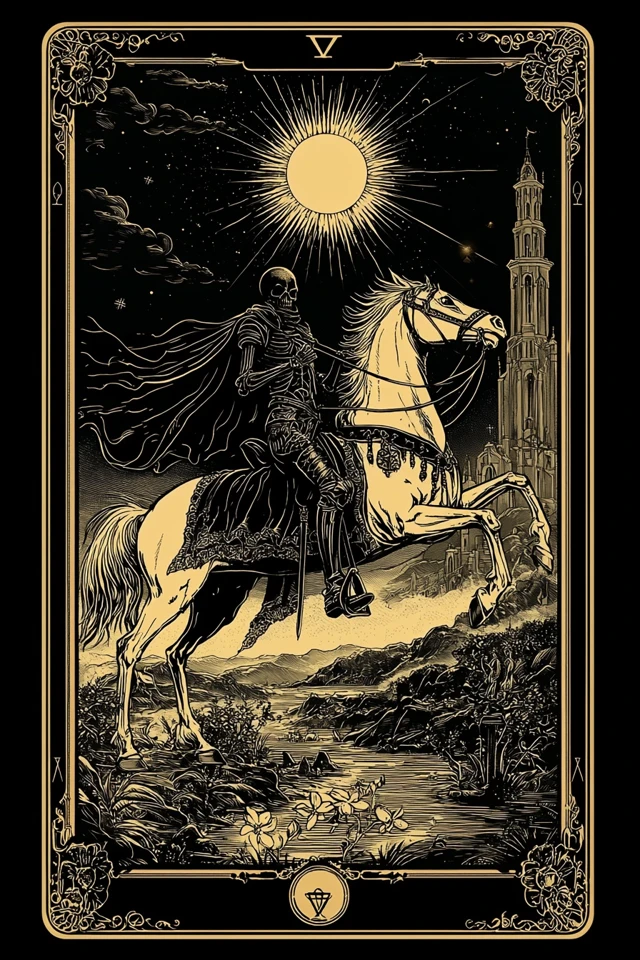
Death Yes or No
Major Arcana · Water · transformation, endings, renewal
Death says no to what was — but yes to transformation. An ending is clearing space for essential renewal.
The end of one relationship chapter and the beginning of another. A relationship may conclude, or a significant transformation occurs within it.
A career, role or project is coming to an end. Clear the old to make way for a more authentic path.
Ego death and rebirth are core to the spiritual path. You are being called to shed old identity layers and emerge renewed.
Why Death leans towards no
Death in tarot rarely means physical death — it heralds profound transformation. Something must end for something new to begin. This transition, though difficult, is deeply necessary and ultimately liberating.
In a yes/no reading: Death advises caution or signals that now is not the right moment. This is not a permanent no — rather an invitation to reassess before moving forward.
The deeper yes/no signal
The Death card is the tarot's most misunderstood and, in many ways, its most philosophically rich card. It almost never indicates physical death — instead, it represents the principle of transformation through ending: the understanding that genuine renewal requires something to actually die first. The skeleton knight rides a white horse (purity of change, not threat) and before him, all human conditions are equal — king and child, bishop and maiden. This is the great leveller: no life remains untouched by endings. The deeper teaching is that we cannot receive what comes next if we haven't genuinely released what's past. Incomplete griefs, avoided endings, clinging to chapters that are finished — these create the stagnation that Death, at its healthiest, comes to dissolve. The card asks what you are ready to release completely, not merely in words but in genuine inner letting go.
Death Reversed — Yes or No?
Death reversed most commonly indicates resistance to a necessary ending — a clinging to something (a relationship, identity, belief, phase of life) that has genuinely run its course, refusing to acknowledge the ending that is already in progress. This resistance is rarely conscious; it often presents as hope that things will change back, or as a frantic redoubling of effort to resuscitate what is no longer alive. It can also indicate stagnation: an inability to move through a transition because the grief of the ending hasn't been genuinely processed. Sometimes the card reversed signals the opposite — a transformation that has been forced too quickly, without adequate grieving of what was lost. The message in either case is the same: real change requires genuine passage, not shortcuts or avoidance.
Death yes or no in love
Death in love is one of the most misread cards in the deck. It is rarely about loss in the simple sense and almost always about transformation — the necessary ending of a chapter so that a truer one can begin. The card appears when a phase of your romantic life has reached its natural completion and continued effort to extend it would only postpone what is already underway. This might be a particular dynamic in a long partnership, an old way of relating, a fantasy that has run its course, or, occasionally, a relationship itself. Whatever is ending, Death asks you to let it end with dignity, because the space cleared by an honest ending is the precondition for genuine renewal.
Frequently Asked Questions
Is Death a yes or no card?
Death is a no card. Death says no to what was — but yes to transformation. An ending is clearing space for essential renewal.
What does Death mean reversed in a yes/no reading?
Reversed, Death shifts its energy. Death reversed most commonly indicates resistance to a necessary ending — a clinging to something (a relationship, identity, belief, phase of life) that has genuinely run its course, refusing to acknowledge the ending that is already in progress. This resistance is rarely conscious; it often presents as hope that things will change back, or as a frantic redoubling of effort to resuscitate what is no longer alive. It can also indicate stagnation: an inability to move through a transition because the grief of the ending hasn't been genuinely processed. Sometimes the card reversed signals the opposite — a transformation that has been forced too quickly, without adequate grieving of what was lost. The message in either case is the same: real change requires genuine passage, not shortcuts or avoidance.
Is Death a good card for love questions?
Death in love is one of the most misread cards in the deck. It is rarely about loss in the simple sense and almost always about transformation — the necessary ending of a chapter so that a truer one can begin. The card appears when a phase of your romantic life has reached its natural completion and continued effort to extend it would only postpone what is already underway. This might be a particular dynamic in a long partnership, an old way of relating, a fantasy that has run its course, or, occasionally, a relationship itself. Whatever is ending, Death asks you to let it end with dignity, because the space cleared by an honest ending is the precondition for genuine renewal.
What does Death say about career questions?
A career, role or project is coming to an end. Clear the old to make way for a more authentic path.
Other No Cards
How to interpret yes/no tarot
In yes/no tarot, each card carries an inherent energy — some lean towards expansion and affirmation, others towards caution and blockage, and several sit in a liminal space of "not yet." Death leans towards no because of its core archetypal energy: transformation, endings, renewal, transition, release. When reading yes/no tarot, consider the card's upright energy as the primary signal, and allow your intuition to sense whether that energy feels amplified or muted in your current situation.