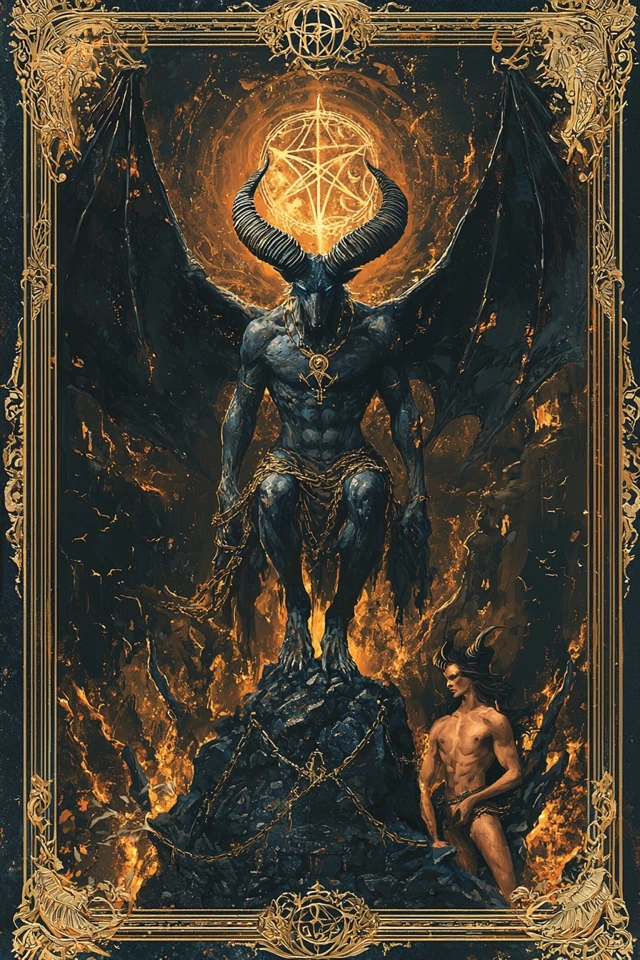
The Devil Yes or No
Major Arcana · Earth · shadow, attachment, bondage
The Devil says no — what you are pursuing may be driven by fear, addiction or unhealthy attachment.
Unhealthy attachment, obsession or a toxic dynamic in the relationship. True intimacy requires freedom, not control.
Greed, ego or a toxic work environment may be trapping you. Examine what you are sacrificing for material gain.
Confront your shadow — the parts of yourself you have denied or suppressed. Integration, not avoidance, brings wholeness.
Why The Devil leans towards no
The Devil confronts you with your shadows — the habits, beliefs and attachments that keep you in chains. Awareness is the first step toward freedom. What are you giving your power away to?
In a yes/no reading: The Devil advises caution or signals that now is not the right moment. This is not a permanent no — rather an invitation to reassess before moving forward.
The deeper yes/no signal
The Devil card is the tarot's most psychologically illuminating image — and arguably its most important for self-examination. The Baphomet figure presides over two chained figures, but look closely at the Rider-Waite image: the chains around the couple's necks are loose. They could remove them. They stay not because they must but because something about the captivity is serving them — comfort, familiarity, the numbing of some deeper pain. This is the card's central teaching: the most significant bondages in human life are chosen, maintained by the parts of us that prefer a known constraint to an unknown freedom. The Devil represents all forms of compulsion, addiction, and self-limitation that are sustained by a lie we tell ourselves about our own helplessness. When he appears, it is almost never to condemn but to illuminate: what are you staying chained to, and what story about yourself makes that staying seem necessary or inevitable?
The Devil Reversed — Yes or No?
The Devil reversed is one of the more hopeful reversals in the deck — it often signals a genuine awakening to a pattern that has held you captive, and the beginning of movement toward freedom. The chains are being noticed, perhaps for the first time with clear eyes. This is rarely comfortable; liberation from a pattern you've been unconsciously maintaining always involves the discomfort of honest reckoning with your own participation in it. The card can also indicate a pattern not yet released but beginning to weaken — addictions in early recovery, compulsions that are becoming conscious, relationships that are being examined more honestly. Less positively, the reversed Devil can sometimes signal a suppression of healthy instincts dressed up as liberation, or the exchange of one form of bondage for another.
The Devil yes or no in love
The Devil in love is the card of strong attachment — the magnetic, often physical pull that binds two people together in ways that can be intoxicating, generative, or quietly imprisoning depending on how consciously the bond is held. At its most affirmative, the card describes powerful chemistry, deep sensuality, and the kind of irresistible attraction that wakes up the body as well as the heart. It can mark the relationships where desire is unmissable and the appetite for one another remains genuinely alive. But the same energy that makes such bonds compelling can also tip into obsession, dependency, or patterns that feel impossible to step out of even when you know you should.
Frequently Asked Questions
Is The Devil a yes or no card?
The Devil is a no card. The Devil says no — what you are pursuing may be driven by fear, addiction or unhealthy attachment.
What does The Devil mean reversed in a yes/no reading?
Reversed, The Devil shifts its energy. The Devil reversed is one of the more hopeful reversals in the deck — it often signals a genuine awakening to a pattern that has held you captive, and the beginning of movement toward freedom. The chains are being noticed, perhaps for the first time with clear eyes. This is rarely comfortable; liberation from a pattern you've been unconsciously maintaining always involves the discomfort of honest reckoning with your own participation in it. The card can also indicate a pattern not yet released but beginning to weaken — addictions in early recovery, compulsions that are becoming conscious, relationships that are being examined more honestly. Less positively, the reversed Devil can sometimes signal a suppression of healthy instincts dressed up as liberation, or the exchange of one form of bondage for another.
Is The Devil a good card for love questions?
The Devil in love is the card of strong attachment — the magnetic, often physical pull that binds two people together in ways that can be intoxicating, generative, or quietly imprisoning depending on how consciously the bond is held. At its most affirmative, the card describes powerful chemistry, deep sensuality, and the kind of irresistible attraction that wakes up the body as well as the heart. It can mark the relationships where desire is unmissable and the appetite for one another remains genuinely alive. But the same energy that makes such bonds compelling can also tip into obsession, dependency, or patterns that feel impossible to step out of even when you know you should.
What does The Devil say about career questions?
Greed, ego or a toxic work environment may be trapping you. Examine what you are sacrificing for material gain.
How to interpret yes/no tarot
In yes/no tarot, each card carries an inherent energy — some lean towards expansion and affirmation, others towards caution and blockage, and several sit in a liminal space of "not yet." The Devil leans towards no because of its core archetypal energy: shadow, attachment, bondage, materialism, awareness. When reading yes/no tarot, consider the card's upright energy as the primary signal, and allow your intuition to sense whether that energy feels amplified or muted in your current situation.